

Application Development
Application development has become one of the most important pillars of modern digital transformation. From mobile phones and net platforms to bed drift software and drivers, drivers work well. For application, scale and competition.
What is Application Development ?
Application improvement is the manner of designing, constructing, checking out, deploying and retaining software program packages. These packages can run on cellular devices, net browsers, desktop computers or cloud structures.
Simply positioned, software development turns an concept into a practical virtual product that users can engage with.
Key Components of App Development
- Planning and requirement analysis
- UI/UX design
- Front-end development
- Back-end development
- Testing and debugging
- Deployment and maintenance
Why Application Development Matters in 2026 ?
App development performs a important position in nearly every enterprise today. Businesses rely on programs to improve efficiency, have interaction clients, and generate sales.
Reasons App Development Is Important
- Digital customer engagement
- Automation of enterprise procedures
- Data-driven choice-making
- Competitive gain
- Scalable growth
With the upward thrust of AI, cloud computing, and far off paintings, utility improvement has turn out to be greater powerful and handy than ever before.
Types of Application Development
Web App Development
Web app development focus on applications that run in browsers. Examples include e commerce websites, dashboards, and SaaS platforms.
Code language/Tools used:
- HTML
- CSS
- JavaScript
- React
- Angular
- Node.js
Mobile App Development
Mobile app development involve building app for Android and iOS devices.
Code language/Tools used:
- Flutter
- React Native
- Swift
- Kotlin
Desktop App Development
Desktop app development focus on software installed on computer.
Examples:
Accounting software, design tools, IDEs
Enterprise App Development
Enterprise app development is used for large-scale business systems like ERP and CRM platforms.
Cloud App Development
Cloud app development build application hosted on cloud platform like AWS, Azure, and Google Cloud.
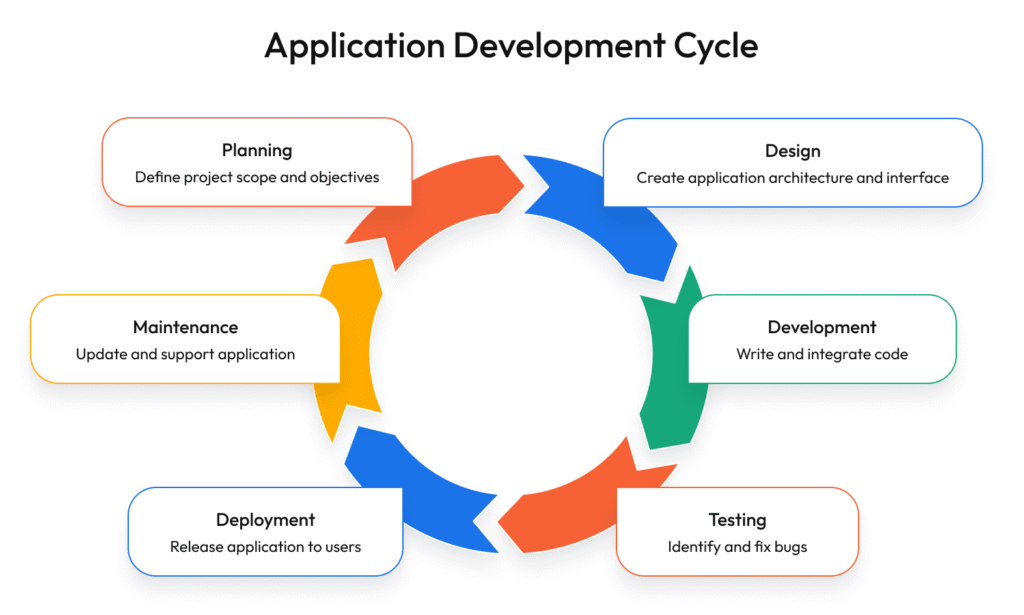
App Development Life Cycle
The app development lifecycle defines the structured approach to building high-quality application.
Requirement Analysis
Understanding business goal, user, and technical requirement.
Design
Creating wireframes , prototypes , and system architectures.
Development
Doing front-end and back-end code.
Testing
Identifying bugs, performance issues, and security vulnerabilities.
Deployment
Launching the application to production.
Maintenance
Updating feature, fixing bug, and improving performance.
Modern Tools Used in Application Development
Front-End Tools
- React.js
- Vue.js
- Angular
Back-End Tools
- Node.js
- Django
- Spring Boot
Databases
- MySQL
- PostgreSQL
- MongoDB
DevOps & CI/CD
Top 7 Trends in App Development
AI Powered App Development
AI tools are automating code generation, testing, or debugging.
Low Code or No Code Platform
These platforms reduce development time and price.
PWAs
PWAs offer app like experiences on browsers.
Cloud-Native Development
Microservices and containers dominate app development.
API-First Development
API enable faster integration and scalability.
Enhanced Application Security
Security is built into every stage of app development.
Cross Platform Development
Single codebases for multiple platforms improve efficiency.
Application Development for Businesses
Application improvement allows companies:
- Improve productivity
- Enhance consumer experience
- Reduce operational fees
- Scale faster
Custom app development gives organizations full manipulate over features and records.
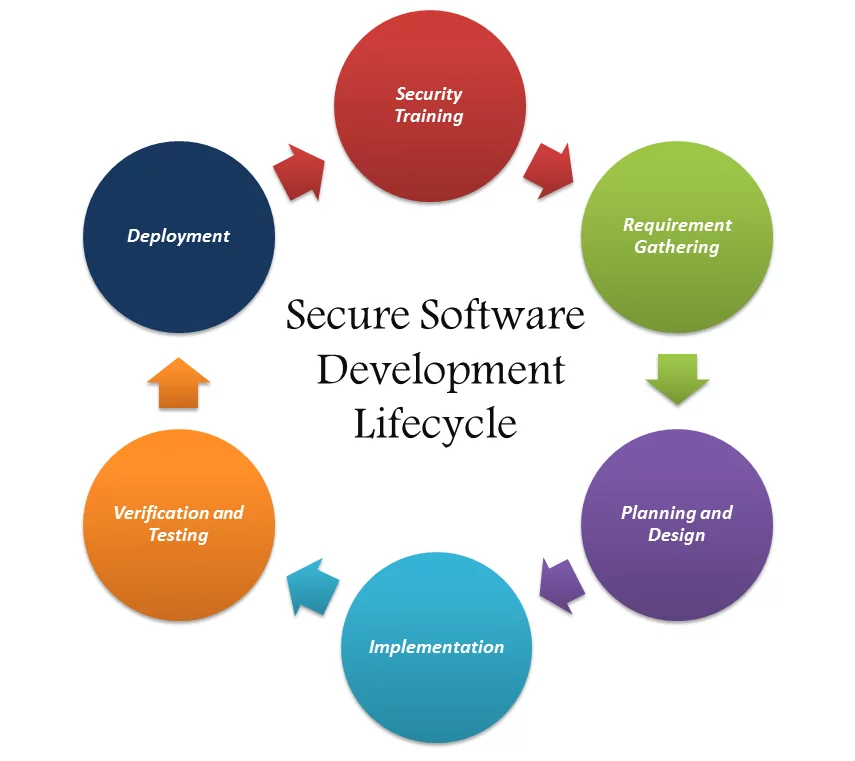
Security in Application Development
Security is a critical part of app development in 2026.
Key Security Practices
- Secure coding standards
- Data encryption
- Authentication and authorization
- Regular security testing
Challenges in Application Development
Despite its benefits, app development comes with challenges:
- Rapid technology changes
- Security threats
- Scalability issues
- High development costs
Planning and choosing the right tools can reduce these risks.
Best Practice for Successful App Development
- Clear requirements
- User-centric design
- Agile development approach
- Continuous testing
- Strong security measures
Following these best practices ensures long term success in app development.
Future of App Development
The future of software development will focus on:
- AI-driven automation
- Smarter applications
- Faster development cycles
- Improved user experiences
App development will continue to evolve as a technology advances.
Conclusion
Application development is the backbone of current digital solutions. In 2026, it is greater advanced, steady, and reachable than ever before. By following first-rate practices, adopting contemporary equipment, and staying up to date with traits, corporations and developers can construct powerful applications that deliver real value.
Whether you are a beginner or an employer, investing in application improvement is not optionally available it’s far critical for growth and fulfillment.