Skip to content
SUBSCRIBE
  • Technology
    Data Protection Trends Report
    Technology
    2024 Data Protection Trends
    January 22, 2026
    Saurav Dhawale
    No posts found
    download - 2025-07-11T141914
    Technology
    Realizing true business value from machine learning
    download - 2025-07-11T145023
    Technology
    Research highlights an emerging trend: Organizations are shifting to private cloud to optimize workloads
    Essential Guide
    Technology
    The Essential Guide to SIEM
    No posts found
    View All
  • HRTech
    download 7
    Hrtech
    The Security Blindspot: Real Attack Insights from Real Browser Attacks
    August 4, 2025
    Saurav Dhawale
    No posts found
    The Total Economic Impact Of Equinix Digital Services
    Hrtech
    The Total Economic Impact Of Equinix Digital Services
    A Survey Of 900 Tech Leaders Reveals Hybrid Cloud Is The Most Effective, Long-Term Strategy
    Hrtech
    A Survey Of 900 Tech Leaders Reveals Hybrid Cloud Is The Most Effective, Long-Term Strategy
    Screenshot-2026-01-30-190621
    Hrtech
    Unlocking Merchant Growth: Building a Payment Roadmap for Success
    No posts found
    View All
  • Finance
    download 32
    Finance
    Key Insights into QSRs' Affordability and Profitability Balancing Act -- And How To Successfully Bridge Gaps
    July 8, 2025
    Saurav Dhawale
    No posts found
    The Power of Certainty: measuring endpoint risk in the public sector
    Finance
    The Power of Certainty: measuring endpoint risk in the public sector
    Tres maneras de ampliar los servicios tecnológicos y seguir reduciendo costos
    Finance
    Tres maneras de ampliar los servicios tecnológicos y seguir reduciendo costos
    Ein datenorientierter Ansatz zur Vereinfachung der komplexen Datenverwaltung
    Finance
    Ein datenorientierter Ansatz zur Vereinfachung der komplexen Datenverwaltung
    No posts found
    View All
  • Marketing
    abm-marketing-powerful-reasons-b2b-growth
    Abm Marketing B2B marketing Marketing Marketing 2025
    7 Powerful Reasons ABM Marketing Transforms B2B Growth in 2025
    December 9, 2025
    Saurav Dhawale
    No posts found
    download25
    Marketing
    The Total Economic Impact™ of VMware Carbon Black Cloud Cost savings and business benefits thanks to Carbon Black Cloud
    photo (9)
    Marketing
    Global Retail Cyber Landscape: Trends, Threats, and Tactics
    How to Measure Behavior
    Marketing
    How to Measure Behavior
    No posts found
    View All
  • Resources
    • Web Development
    • Technology 2025
    • Supply Chain
    • Storage
    • Security
    • Networking And Communication
    • MSP
    • Library
    • IT Security
    • IT Management
    • IT Infrastructure
    • IOT
    • Global Trade
    • Stock Market
    • Insurances
    • Banking
    • Finance 2025
    • ERP
    • Ecommerce
    • Ebook
    • Digital Advertising
    • Data Security
    • Data Management
    • Content Marketing
    • Cloud Migration
    • Cloud Computing
    • Big Data
    • B2B Marketing
    • Audit And Compliance
    • Artificial Intelligence
    • Application Development
    • API
    • Analytics
    • Abm Marketing
  • Contact
  • About
    • Privacy Policy
    • Terms of Use
    • Cookies Notice
  • work-with-us
    • Advertise With-Us
  • Technology
    Transform your sales team’s productivity with Slack
    Technology
    Transform your sales teams productivity with Slack
    January 28, 2026
    Saurav Dhawale
    No posts found
    Machine-Learning-Explained-in-2025-A-Powerful-Beginner-to-Advanced-Guide
    Technology
    Machine Learning Explained in 2025: A Powerful Beginner-to-Advanced Guide
    download (33)
    Technology
    Harnessing the Power of Smart Stores
    download20
    Technology
    Empowering Enterprises with AI Entering the Era of Choice
    No posts found
    View All
  • HRTech
    Taking the Pain Out of Tax
    Hrtech
    Taking the Pain Out of Tax
    January 22, 2026
    Saurav Dhawale
    No posts found
    Replacing your current cloud phone with Zoom Phone is as easy as 1-2-3
    Hrtech
    Replacing your current cloud phone with Zoom Phone is as easy as 1-2-3
    Why a Modern Digital Work Environment Matters and How to Achieve it
    Hrtech
    Why a Modern Digital Work Environment Matters and How to Achieve it
    Deploy a Scalable CTEM Program to Proactively Mitigate Business Threats
    Hrtech
    Deploy a Scalable CTEM Program to Proactively Mitigate Business Threats
    No posts found
    View All
  • Finance
    2023 Executive Survey
    Finance
    2023 Executive Survey: The power of mobilizing the boundless workforce - Duplicate - [#11504]
    January 22, 2026
    Saurav Dhawale
    No posts found
    download 56
    Finance
    Protecting Your C-Store Against the Hidden Costs of Compliance Violations
    A CIO’S Guide to Navigating the Boardroom
    Finance
    A CIO’S Guide to Navigating the Boardroom
    Software bill of materials (SBOM)
    Finance
    Software bill of materials (SBOMs) a critical component of software supply chain security
    No posts found
    View All
  • Marketing
    Digital-Marketing-15-Powerful-Growth-Strategies-for-2025
    Content Marketing Digital Advertising Marketing Marketing 2025
    Digital Marketing: 15 Powerful Growth Strategies for 2025
    December 15, 2025
    Saurav Dhawale
    No posts found
    5 Ways Customer Loyalty is Evolving
    Marketing
    5 Ways Customer Loyalty is Evolving
    How-B2B-Tech-Publishers-Can-Use-Google-Ads-to-Boost-Lead-Quality
    Analytics
    How B2B Tech Publishers Can Use Google Ads to Boost Lead Quality
    The Wise Guide: The Do’s and Don’ts of Data Storage From Our Customers Point of View
    Marketing
    The Wise Guide: The Do’s and Don’ts of Data Storage From Our Customers Point of View
    No posts found
    View All
  • Resources
    • Web Development
    • Technology 2025
    • Supply Chain
    • Storage
    • Security
    • Networking And Communication
    • MSP
    • Library
    • IT Security
    • IT Management
    • IT Infrastructure
    • IOT
    • Global Trade
    • Stock Market
    • Insurances
    • Banking
    • Finance 2025
    • ERP
    • Ecommerce
    • Ebook
    • Digital Advertising
    • Data Security
    • Data Management
    • Content Marketing
    • Cloud Migration
    • Cloud Computing
    • Big Data
    • B2B Marketing
    • Audit And Compliance
    • Artificial Intelligence
    • Application Development
    • API
    • Analytics
    • Abm Marketing
  • Contact
  • About
    • Privacy Policy
    • Terms of Use
    • Cookies Notice
  • work-with-us
    • Advertise With-Us
Home » Application Development
Category:

Application Development

Custom Applications Fail When Business Workflows
Application Development

Why Custom Applications Fail When Business Workflows Are Not Clear

by ailcia sierra July 7, 2026
written by ailcia sierra

Companies in all kinds of industries are spending a lot of money on transformation and software development. They want to make their operations better get more work done and make their customers happy. A lot of companies now use custom applications to manage their work, automate tasks talk to each other and make decisions. These custom applications are made for them so they fit the companys needs and goals.

Even though companies are spending a lot of money on software development a lot of custom applications do not work as well as they should. Some projects take long cost too much money or people do not want to use them. Sometimes they even stop working after they are finished. One big reason this happens is that the companys workflows are not clear during the development process.

Workflows are like a plan that shows how things get done inside a company. This includes tasks, approvals, moving data around talking to each other and getting work done. If these workflows are not understood or written down the development team has a time making an application that really helps the company. This causes confusion, between the team, management and the people who use the application. It leads to software that does not work well and workflows that do not match up. Companies need to understand their business workflows to make custom applications that really work for them and their business workflows.

What Are Custom Applications in Modern Businesses?

Custom business applications represent specific software systems developed according to the requirements of a particular business entity.

In contrast to generic software systems, customized applications are created specifically to help companies improve their operations.

Main Features

  • Workflows oriented functionality
  • Automation capacity
  • Focused software design
  • Customized operation assistance
What Are Custom Applications in Modern Businesses?

Custom Business Applications Types

  1. Enterprise Workflows Applications: Software applications designed to manage operations within the company.
  2. Customer Management Applications: Software systems aimed at managing customer relations and interactions.
  3. Operation Automation Applications: Software systems that help automate routine business operations.

Why Undefined Workflows Lead to Software Failure

Business workflows serve as a basis of the software development process. Lack of information about a workflow leads to poor software design and inability to meet the client’s needs.

Features

  • Unclear workflow design
  • Lack of proper process management
  • Poor communication between project participants
  • Operational Inefficiencies

Impact of Unclear Workflows on Software Projects

Workflow ProblemBusiness Impact
Undefined processesDevelopment confusion
Poor communicationDelayed projects
Inconsistent operationsUser frustration
Missing workflow documentationIncreased software errors

Role of Workflow Mapping in Application Development

Workflow mapping allows companies to map out how workflows progress from one department to another.

Through workflow mapping, businesses are able to foster collaboration between technical and operational staff members.

Key Characteristics

  • Workflow visualization
  • Greater operational clarity
  • Efficient development
  • Lower risk of workflow misalignment

Types of Workflow Mapping

  1. Process Flow Mapping: Illustrates how processes flow within operational systems.
  2. Data Flow Mapping: Maps the flow of data between departments.
  3. Approval Workflow Mapping: Outlines processes involved in decision making and authorization.

How Poor Communication Affects Custom Application Projects

Challenges related to communication among stakeholders, developers, and operational departments have been identified as the most common reasons for software project failure.

When there is inconsistency in software development requirements or frequent changes, software development becomes very difficult.

Key Characteristics

  • Inconsistent requirement specifications
  • Delayed development
  • Conflict of interest between stakeholders
  • Higher operational risk

Importance of User-Centric Design in Software Applications

User experience plays an essential role in custom software application development projects. Without considering user behavior, the use of software applications in operations becomes very low.

Key Characteristics

  • Enhanced user experience
  • Workflow-friendly design
  • Increased software usage
  • Operational efficiency

User-Centric Design Benefits

Design ElementBusiness Benefit
Simplified interfacesBetter usability
Workflow alignmentHigher productivity
Faster navigationReduced training time
Mobile accessibilityImproved flexibility

Operational Challenges in Custom Application Development

Many organizations underestimate the complexity of operational processes during software planning. This leads to applications that automate isolated tasks instead of supporting complete business workflows.

Key Features

  • Cross-department workflow complexity
  • Data integration challenges
  • Process inconsistencies
  • Limited operational visibility

Types of Operational Challenges

  1. Departmental Silos: Teams operate independently without workflow coordination.
  2. Legacy System Dependencies: Older systems limit software flexibility.
  3. Workflow Variability: Business processes change frequently over time.

What Are Custom Applications in Modern Businesses?

How AI Is Improving Workflow Management

Artificial intelligence is helping businesses analyze workflows and improve software planning. AI-powered systems can identify inefficiencies, automate repetitive tasks, and optimize operational processes.

Key Features

  • AI-driven workflow analysis
  • Predictive operational insights
  • Intelligent automation systems
  • Process optimization support

AI Benefits in Workflow Optimization

AI CapabilityBusiness Benefit
Workflow analyticsBetter process visibility
Automation supportIncreased efficiency
Predictive insightsSmarter planning
Process monitoringReduced operational errors

Role of Business Process Management (BPM)

Business Process Management helps organizations standardize workflows before application development begins. BPM strategies improve operational clarity and reduce software implementation risks.

Key Features

  • Process standardization
  • Workflow optimization
  • Better operational governance
  • Improved software alignment

How Agile Development Helps Reduce Workflow Confusion

Agile development methods improve collaboration between technical and business teams. Instead of building software all at once, agile teams develop applications in smaller phases with continuous feedback.

Key Features

  • Incremental software development
  • Faster feedback cycles
  • Better workflow adaptation
  • Reduced project risks

Why Digital Transformation Projects Fail Without Clear Processes

Digital transformation projects often fail when companies focus much on technology and not enough on how work gets done.

  • Businesses spend money on cloud systems, automation tools and software without understanding how employees do their jobs.
  • This causes confusion people don’t use the tools and work gets slower.
  • Successful digital transformation requires companies to match technology plans with steps and goals.

Key Features

  • Transformation based on workflows
  • planning
  • Software used effectively
  • Risks reduced
What Are Custom Applications in Modern Businesses?

How Workflow Automation Makes Business Efficient

Workflow automation helps businesses do away with repetitive tasks and makes work more consistent.

  • Automation tools make approvals, reports and task management easier.
  • This reduces mistakes boosts productivity and lets employees focus on work.

Key Features

  • Tasks done automatically
  • Work processes
  • Fewer mistakes
  • Productivity increased

Role of AI in Improving Business Processes

Artificial intelligence is becoming a tool for analyzing and improving business operations.

  • AI systems watch workflows find problems predict bottlenecks and suggest improvements.
  • Businesses use AI to boost productivity, customer experiences and workflow management.

Key Features

  • AI analytics
  • Insights, into operations
  • Smart workflow management
  • Process improvements

Why User Adoption Matters for Software Success

Even the best software can fail if employees don’t use it right.

  • User adoption depends on how easy it’s to use if it fits with workflows, training and relevance.
  • Businesses that involve employees in planning and design often get results and more productivity.

Key Features

  • Software designed for employees
  • Easier to use
  • engagement
  • Better adoption

Future of Low-Code and No-Code Application Development

Low-code and no-code platforms are changing how businesses build software.

  • These platforms let organizations build workflow-driven apps quickly without needing to know a lot of code.
  • Businesses can be more flexible save money and adapt apps faster as workflows change.

Key Features

  • Faster app development
  • Technical dependency
  • Customization focused on workflows
  • More agility

Future of Workflow-driven Application Development

Future developments in software applications will revolve around workflow intelligence, automation, and operational analysis using AI.

Companies will adopt predictive workflows to enhance their application operations and efficiency.

Features

  • Workflow automation powered by intelligence
  • Application design using artificial intelligence
  • Predictive process management
  • Operational analytics

Conclusion

Custom applications are really important for businesses to get better at what they do to automate the things they need to do every day and to help with their plans for transformation.. A lot of software projects do not work out because companies start building them without really knowing how their business works from day to day.

When companies do not understand their workflows it can cause problems with people talking to each other it can make things less efficient. It can make it hard for people to use the software. To make sure that the application development process works companies need to write down what their workflows are get the people who do the work involved and make sure the technology they use fits with how thingsre really done.

Things like intelligence looking at workflows to see how they can be improved, developing software in a flexible way and managing business processes are helping companies make software implementation less risky and make their operations clearer. Companies that focus on understanding their workflows and making software that’s easy for people to use are more likely to make applications that work well and can be used by a lot of people.

In the future making applications will be more, about understanding workflows using systems and automating things. Companies that understand how their business works and use technology will be able to do things more efficiently get people to use their software more and have their business grow over time. Custom applications will be a part of this. Businesses will use custom applications to get better at what they do. They will use custom applications to automate their workflows.. They will use custom applications to support their digital transformation strategies.

Frequently Asked Questions:
  1. Why do custom applications fail?

Custom applications often fail because business workflows are not clear or not well documented before development starts.

  1. What is workflow mapping, in software development?

Workflow mapping is a way for businesses to see how they work and make software planning better.

  1. How does AI improve workflow management?

AI looks at workflows finds problems and helps make processes automatic and better.

  1. Why is user-centric software design important?

User-centric design makes software easier to use. That makes people use it more and work better.

  1. What is the future of workflow-driven software development?

The future of workflow-driven software development includes using AI to automate workflows predict what will happen and make operational systems smarter.


July 7, 2026 0 comment
0 FacebookTwitterPinterestEmail
Application Development

Application Development Guide: How Modern Apps Are Built, Scaled & Managed

by ailcia sierra April 27, 2026
written by ailcia sierra

In today’s fast-moving digital world, where almost everything runs through the internet, applications have become crucial components of virtually any business today. Whether we think about shopping and banking, education and entertainment, mobile or desktop applications, the world of businesses is now all about developing and improving apps.

Each app that reaches consumers has undergone a thorough development process which usually involves such stages as design, development itself, testing, deployment, scaling and managing an application for quite some time. The process of creating applications goes much further than simply programming.

Knowing all the intricacies behind developing an application enables us to make businesses’ digital lives better and more efficient. Here you will find a complete guide on developing apps.

Application Development Explained

Application development refers to the creation of application programs for execution either on a computer, web browser, or any other portable device such as smartphones.

Important Things to Remember

  • It involves both mobile applications and web applications.
  • It includes aspects of design and coding and testing.
  • Problem-solving approach.
  • Continuous improvement.

Types of Application Development

TypeDescription
Mobile DevelopmentApps for Android & iOS
Web DevelopmentBrowser-based applications
Desktop AppsSoftware for computers
Hybrid AppsCombination of web + mobile

Application Development Life Cycle

The life cycle of an application entails several phases that lead to a fully operational product. Each of the phases guarantees the successful outcome of the application.

Main Points

  • Generation of ideas
  • Designing UI/UX
  • Development process
  • Testing process
  • Deployment and Maintenance of the product

Modern Applications Creation Process

In the modern age, apps are created using sophisticated methods. The developers prioritize speed, performance, and user experience.

Main Points

  • App creation using modern frameworks
  • Use of cloud platforms
  • Agile development process
  • Functionality through API integration

Technology Stack Used in Modern Apps

LayerTechnologies Used
FrontendReact, Angular, Flutter
BackendNode.js, Python, Java
DatabaseMySQL, MongoDB
CloudAWS, Azure, Google Cloud

Scaling Apps for Growth

The scaling process guarantees that applications can accommodate more users and data without any problems. It is necessary for growth and user satisfaction.

Key Points

  • Manages increased traffic
  • Increases performance
  • Relies on cloud infrastructure
  • Enables business growth

Managing Applications

Application management guarantees that applications keep running efficiently after deployment. It includes monitoring, updates, and performance improvement.

Key Points

  • Updates and bug fixes
  • Monitoring performance
  • Security improvements
  • Feedback from users

Application Management Activities

ActivityPurpose
MonitoringTrack performance
UpdatesAdd new features
SecurityProtect user data
OptimizationImprove speed

Modern Trends in Application Development

Technology keeps changing. Now making apps is getting smarter, quicker and more automatic.

Key Points

  • Apps that use Artificial Intelligence
  • Systems made for the Cloud
  • Building apps, with services
  • Platforms that need little or no coding

DevOps in Application Development

DevOps is about bringing development and operations teams. This helps to deliver software and work more efficiently.

Key Points

  • We focus on integration to streamline our process.
  • Faster deployment cycles mean we can get things done quicker.
  • Better collaboration, between teams is essential.
  • Reduced errors make our software more reliable.

DevOps Workflow

StageFunction
CodeDevelopment phase
BuildCompile application
TestQuality check
DeployRelease application

UX in Applications

UX is crucial in influencing users’ experience when using applications.

Key Points

  • Simplified navigation
  • Quick reaction time
  • Neat design
  • Friendly user interface

Security in Application Development

Security ensures that the user data and application systems are protected from any danger.

Key Points

  • Data encryption
  • Authentication
  • Adequate auditing
  • API security

Security Measures

FeaturePurpose
EncryptionProtect data
AuthenticationVerify users
FirewallBlock threats
API SecuritySecure communication
Security in Application Development

Cloud-Based Application Development

Cloud technology enables applications to scale easily and operate efficiently.

Key Points

  • Flexible scaling
  • Lower infrastructure cost
  • Remote accessibility
  • High reliability

API Integration in Modern Apps

APIs connect applications with external systems and services.

Key Points

  • Adds external features
  • Saves development time
  • Improves functionality
  • Supports scalability

API Benefits

BenefitImpact
IntegrationConnect systems
EfficiencyFaster development
FlexibilityAdd features easily

Application Testing and Quality Assurance

When we make an application it has to be tested a lot before it’s available to everyone. This testing is very important because it makes sure the application works the way it should it is fast. People who use it have a good time. Testing finds problems with the application, like things that do not work right and parts that are slow before people start using it.

Key Points

  • The application testing makes sure the application works without any mistakes
  • It makes the application run faster and better
  • It finds bugs in the application before it is released to the public
  • It makes the application more enjoyable and reliable, for the people who use the application, which’s the main goal of application testing and Quality Assurance.

Types of Application Testing

Type of TestingPurpose
Functional TestingChecks if features work correctly
Performance TestingMeasures speed and stability
Security TestingIdentifies vulnerabilities
Usability TestingChecks user experience

Why Testing is Important

Testing is super important not at the end but throughout building an app. It makes sure the app is good and people can trust it.

Key Points

  • Testing prevents app crashes after launch
  • It also reduces long-term maintenance cost
  • Testing improves customer satisfaction
  • It builds brand reliability through testing

Testing is key, to an app and we need to do it right. Testing helps in ways.

Best Practices in Application Development

When we make applications it is very important to do things the way. This means our applications will work well and people will like them for a time.

Key Points

  • We need to think about what the user needs from our application
  • We should use methodology to make our application
  • We have to test our application all the time
  • We need to make sure our application works fast and well

Challenges in Application Development

People who make applications have a lot of problems when they are building new applications.

Key Points

  • It is hard to design a system that’s not too complicated
  • There are a lot of security risks that we need to think about
  • It costs a lot of money to make an application
  • We have to make sure our application can handle a lot of users without any problems, with Application Development.

Challenges vs Solutions

ChallengeSolution
PerformanceCode optimization
SecurityEncryption & audits
CostCloud adoption
ScalingDistributed systems

Future of Application Development

The future of application development is really going to be shaped by Artificial Intelligence, automation and cloud computing. Application development is going to change because of these things. The future of application development will be different.

Key Points

  • Application development is going to use Artificial Intelligence to make things better
  • We will see faster deployment cycles for application development
  • Application development will make applications
  • There will be more automation, in application development

Conclusion

Application development is not about writing code. It is about taking an idea and turning it into a working software solution. This means going through steps. You have to plan it design it write the code test it put it out there make sure it can handle a lot of users and keep it running smoothly. Each of these steps is important if you want to make an app.

People who use apps expect a lot from them now. They want apps that’re fast strong and easy to use. Companies that do things the way and use the latest technology can make better apps and get better results.

To make an app you have to keep making it better. You have to make choices and be able to change when you need to. Application development is, about doing each step well. The better you do each step the better your app will be. If you do everything right from planning to maintenance you will have an application.

Frequently Asked Questions

1. What is application development in terms?

Application development is when you make a software program for people to use on their mobile, web or desktop. This means you have to design it build it test it and make sure it keeps working

2. What are the main stages of application development?

When you make an application you have to do a things. The main stages of application development are planning, designing, development, testing, deployment, scaling and maintenance

3. Why is scaling important in applications?

Scaling is important in applications because it helps the application work properly when a lot of people are using it. If you do not scale your application it might get slow or even crash when many people are on it. So scaling helps the application handle users and traffic.

4. What technologies are used in app development?

In app development people use a lot of different technologies. They use things like React, Flutter and Node.js to build the application. They also use cloud platforms and databases like MongoDB or MySQL to store information.

5. What is Agile in application development?

Agile is a way of making applications where you build them in parts. You get feedback from people. Then you make the application better. This way of making applications is flexible so you can change things as you go along. Application development with Agile is, about making the application development process work better.

April 27, 2026 0 comment
0 FacebookTwitterPinterestEmail
Application-Development-in-2026:7-Powerful-Trends-Tools,-and-Best-Practices-You-Must-Know
Application Development

Application Development in 2026: 7 Powerful Trends, Tools, and Best Practices You Must Know

by Saurav Dhawale January 9, 2026
written by Saurav Dhawale

Application Development

Application development has become one of the most important pillars of modern digital transformation. From mobile phones and net platforms to bed drift software and drivers, drivers work well. For application, scale and competition.

What is Application Development ?

Application improvement is the manner of designing, constructing, checking out, deploying and retaining software program packages. These packages can run on cellular devices, net browsers, desktop computers or cloud structures.

Simply positioned, software development turns an concept into a practical virtual product that users can engage with.

Key Components of App Development

  • Planning and requirement analysis
  • UI/UX design
  • Front-end development
  • Back-end development
  • Testing and debugging
  • Deployment and maintenance
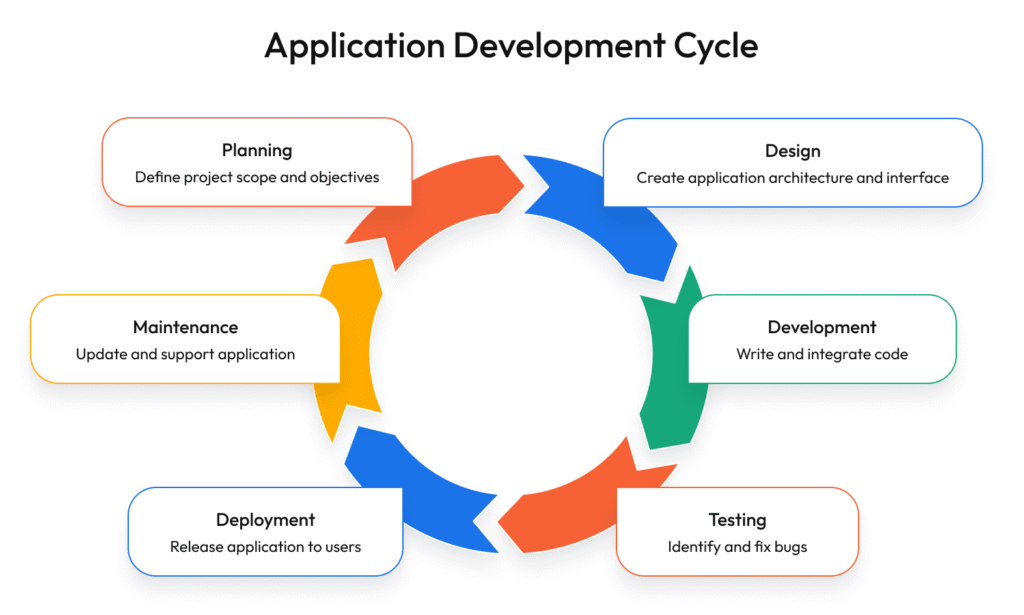
 Application development process showing planning, design, coding, testing, and deployment stages

Why Application Development Matters in 2026 ?

App development performs a important position in nearly every enterprise today. Businesses rely on programs to improve efficiency, have interaction clients, and generate sales.

Reasons App Development Is Important

  • Digital customer engagement
  • Automation of enterprise procedures
  • Data-driven choice-making
  • Competitive gain
  • Scalable growth

With the upward thrust of AI, cloud computing, and far off paintings, utility improvement has turn out to be greater powerful and handy than ever before.

Types of Application Development

Web App Development

Web app development focus on applications that run in browsers. Examples include e commerce websites, dashboards, and SaaS platforms.

Code language/Tools used:

  • HTML
  • CSS
  • JavaScript
  • React
  • Angular
  • Node.js

Mobile App Development

Mobile app development involve building app for Android and iOS devices.

Code language/Tools used:

  • Flutter
  • React Native
  • Swift
  • Kotlin

Desktop App Development

Desktop app development focus on software installed on computer.

Examples:
Accounting software, design tools, IDEs

Enterprise App Development

Enterprise app development is used for large-scale business systems like ERP and CRM platforms.

Cloud App Development

Cloud app development build application hosted on cloud platform like AWS, Azure, and Google Cloud.

App Development Life Cycle

The app development lifecycle defines the structured approach to building high-quality application.

Requirement Analysis

Understanding business goal, user, and technical requirement.

Design

Creating wireframes , prototypes , and system architectures.

Development

Doing front-end and back-end code.

Testing

Identifying bugs, performance issues, and security vulnerabilities.

Deployment

Launching the application to production.

Maintenance

Updating feature, fixing bug, and improving performance.

Modern Tools Used in Application Development

Front-End Tools

  • React.js
  • Vue.js
  • Angular

Back-End Tools

  • Node.js
  • Django
  • Spring Boot

Databases

  • MySQL
  • PostgreSQL
  • MongoDB

DevOps & CI/CD

  • Docker
  • Kubernetes
  • GitHub Actions

Top 7 Trends in App Development

AI Powered App Development

AI tools are automating code generation, testing, or debugging.

Low Code or No Code Platform

These platforms reduce development time and price.

PWAs

PWAs offer app like experiences on browsers.

Cloud-Native Development

Microservices and containers dominate app development.

API-First Development

API enable faster integration and scalability.

Enhanced Application Security

Security is built into every stage of app development.

Cross Platform Development

Single codebases for multiple platforms improve efficiency.

Application Development for Businesses

Application improvement allows companies:

  • Improve productivity
  • Enhance consumer experience
  • Reduce operational fees
  • Scale faster

Custom app development gives organizations full manipulate over features and records.

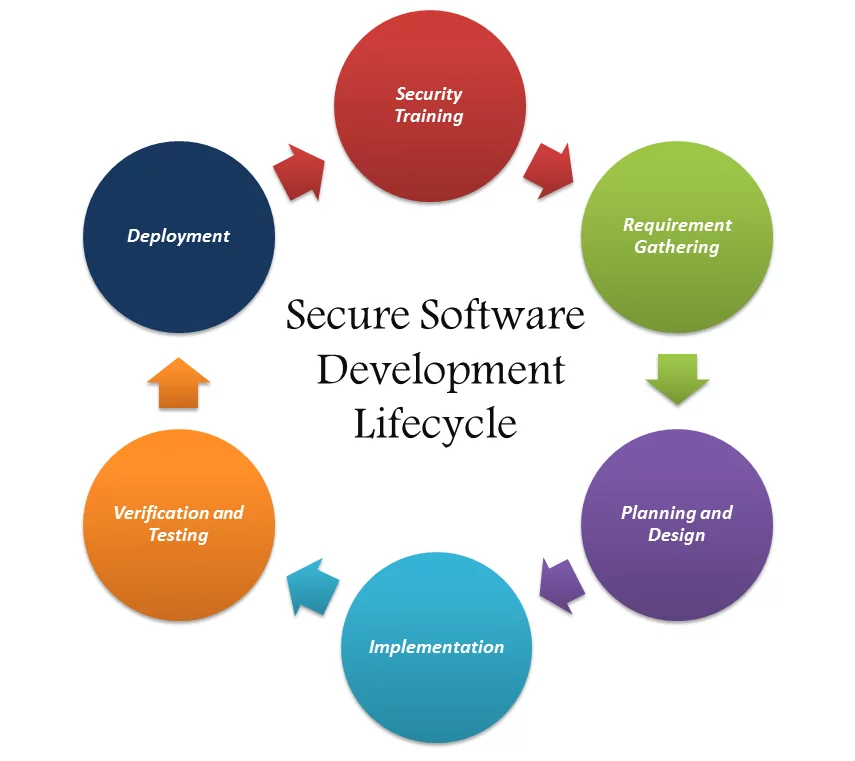
Security in Application Development

Security is a critical part of app development in 2026.

Key Security Practices

  • Secure coding standards
  • Data encryption
  • Authentication and authorization
  • Regular security testing
Secure application development with data protection concepts

Challenges in Application Development

Despite its benefits, app development comes with challenges:

  • Rapid technology changes
  • Security threats
  • Scalability issues
  • High development costs

Planning and choosing the right tools can reduce these risks.

Best Practice for Successful App Development

  • Clear requirements
  • User-centric design
  • Agile development approach
  • Continuous testing
  • Strong security measures

Following these best practices ensures long term success in app development.

Future of App Development

The future of software development will focus on:

  • AI-driven automation
  • Smarter applications
  • Faster development cycles
  • Improved user experiences

App development will continue to evolve as a technology advances.

Conclusion

Application development is the backbone of current digital solutions. In 2026, it is greater advanced, steady, and reachable than ever before. By following first-rate practices, adopting contemporary equipment, and staying up to date with traits, corporations and developers can construct powerful applications that deliver real value.

Whether you are a beginner or an employer, investing in application improvement is not optionally available it’s far critical for growth and fulfillment.

January 9, 2026 0 comment
0 FacebookTwitterPinterestEmail
AI in Application Development transforming how apps are built in 2025
Application Development

AI in Application Development: Transforming How Apps Are Built in 2025

by Saurav Dhawale August 21, 2025
written by Saurav Dhawale

Introduction

Artificial Intelligence (AI) has reshaped industries worldwide, and the software sector is no exception. AI in Application Development has become a driving force behind how businesses build, deploy, and scale applications in 2025. From automating repetitive coding tasks to enhancing user experience with personalized features, AI is no longer a futuristic concept—it is today’s competitive advantage. Companies that leverage AI are able to cut development costs, improve efficiency, and deliver highly adaptive applications to meet modern demands.

What is AI in Application Development?

AI in Application Development refers to the use of machine learning, natural language processing (NLP), and generative AI models to automate coding, testing, debugging, and optimization. It transforms traditional software engineering by:

  • Automating repetitive tasks like writing boilerplate code.
  • Improving app quality through AI-driven testing.
  • Enhancing personalization with predictive analytics.
  • Optimizing development cycles with faster deployments.

In essence, AI shifts development from manual, time-consuming processes to intelligent, adaptive workflows.


Key Ways AI is Transforming Application Development in 2025

1. Automated Code Generation

Generative AI tools such as GitHub Copilot and ChatGPT have become virtual pair programmers. These tools can generate error-free code snippets, suggest alternatives, and even document code automatically. This drastically reduces development time while helping developers focus on solving complex problems instead of routine tasks.

2. Smarter Testing and Debugging

One of the most time-intensive phases of software development is testing. With AI in Application Development, testing frameworks can predict potential bugs, perform automated regression tests, and even simulate real-user behavior. This ensures better product quality and minimizes downtime during release cycles.

3. Personalized User Experiences

AI-driven applications leverage data to predict user preferences, enabling personalized app experiences. Whether it’s e-commerce recommendations, AI-driven chatbots, or adaptive interfaces, applications built with AI are more engaging and user-friendly.

4. Security and DevSecOps Integration

Cybersecurity is a major concern in 2025. AI in Application Development plays a key role in DevSecOps, identifying vulnerabilities early and applying predictive models to counter security risks. By integrating security into the development pipeline, businesses can safeguard sensitive data and maintain compliance.

5. Accelerating Agile and DevOps

Agile teams thrive on speed and adaptability. With AI, development pipelines are faster and more accurate. AI-based project management tools forecast delivery times, allocate resources intelligently, and streamline the entire DevOps lifecycle, allowing companies to launch products faster without compromising quality.

6. Cost-Effective Development

AI reduces the need for large development teams by automating repetitive tasks. Businesses can build scalable applications at a fraction of the traditional cost. This democratizes software development, enabling startups and enterprises alike to innovate more efficiently.


Real-World Examples of AI in Application Development

  • Healthcare Apps: AI-driven diagnostic applications providing real-time patient data analysis.
  • E-Commerce: Platforms offering hyper-personalized product recommendations and AI-powered virtual assistants.
  • Banking & Finance: Fraud detection systems embedded within mobile apps to secure transactions.
  • Education: Intelligent learning platforms that adapt to students’ progress and personalize course recommendations.

These examples show how industries are leveraging AI in Application Development to create smarter, faster, and more responsive applications.

Challenges of AI in Application Development

While opportunities are vast, businesses must also address challenges:

  • Data Privacy Concerns: Handling user data responsibly.
  • Ethical AI Use: Avoiding bias in algorithms.
  • Integration Costs: Ensuring AI fits seamlessly with existing infrastructure.
  • Skill Gaps: Training developers to effectively use AI-powered tools.

Overcoming these hurdles will be essential for maximizing the value of AI in software engineering.

Final Thoughts

AI in Application Development is more than a trend—it’s a transformation that defines how apps are created in 2025. From automated coding to smarter testing and personalized user experiences, AI empowers businesses to innovate faster and with greater efficiency. Companies that adopt AI-driven development now are positioning themselves as leaders in a digital-first world. As we move forward, the future of application development will be defined not by manual coding alone, but by the synergy between developers and AI.

August 21, 2025 0 comment
0 FacebookTwitterPinterestEmail
Illustration showing how Serverless Computing manages backend operations like scaling and maintenance automatically
Application DevelopmentCloud Computing

The Rise of Serverless Computing: Revolutionizing Cloud Development

by Saurav Dhawale May 23, 2025
written by Saurav Dhawale

What is Serverless Computing?

Serverless Computing is a male signing model where shooters automatically manage server infrastructure. Developers focus on writing code, while backand operations such as scaling, patching and delivery are controlled by platforms such as AWS Lambda, Azure feature and Google Cloud features.

Despite the name, the Serverless Computing does not mean that there are no servers. Instead, this means that developers no longer need to manage them directly. This allows abstract teams to focus on construction facilities and improve the user experience without worrying about the underlying infrastructure. Server -free also quickly enables the peripheral cycle and spontaneous scalability to handle separate workloads.

The benefits of server -free architecture

Server -Free data processing has gained rapid popularity due to the following benefits:

  • Cost effectiveness: You only pay for the time when your code is performed.
  • Scalability: automatically up or down depending on demand.
  • The market quickly time to other: Developers can distribute updates quickly.
  • Low maintenance: Cloud suppliers handle server maintenance and uptime.

These benefits make modern cloud applications, especially a server -free architecture for startups and supple teams that want to reduce overheads.

Popular Use Cases of Serverless

Many companies use Serverless Computing processing for a series of applications:

  1. Real -time file processing -like, image or video upload.
  2. Restful API – Backnd Services that are on scale with user demand.
  3. IoT Backnd – Handle Unexpected Unit Communication.
  4. Planned Tasy – authors of maintenance and data lines.

For example, Netflix and Airbnb Cloud Computing Services use as AWS Lambda for scalable microsarrus.

Challenges with Serverless Computing

While servers have many benefits, it is not without limitations:

  • Cold start: Delay in the performance of the function after becoming inactive.
  • Seller lock: Hard migration between platforms.
  • Limited execution time: Not suitable for long flow procedures.
  • Troubleshooting complexity: It is difficult to monitor distributed events.
  • Resource restrictions: Most platforms use memory, execution time and payload limit limit, which may interfere with some applications.

It is important to understand these deficiencies before using server -free architecture for applications for mission materials. Teams should plan around these challenges to get the benefits of Serverless Computing processing.

Top Serverless Platforms

If you are considering using serverless data processing, there are some top platforms to find out:

  • AWS Lambda – with the most popular, rich integration and social support.
  • Microsoft Azure Function – spontaneous integration with other Azure services.
  • Google Cloud Function ideal for GCP-based apps.
  • Cloudflare EDGE-based function for work-demon-focused apps.

These platforms provide unique features to the platform teams to adapt the costs and performance of Skyriser.

Server -Free’s future in Cloud Computing

The growth of cloud computing operates innovation in Serverless Computing technologies. 2025 and beyond we expect:

  • Broad adoption for businesses
  • Better developer equipment
  • Hybrid and multi-cloud support
  • Edge calculation increased increase in integration

Since companies require rapid distribution and infrastructure headheads, Serverless Computing data processing will play an important role in modern software architecture. In addition, we can guess progress in observation, safety tools and stronger structure that makes the building’s complex application easier. As the demand for AI and real -time data increases, scalable will be an important promoter promotional, event -driven solutions in serverless industries.

Conclusion

Serverless Computing data processing is no longer a niche trend – this is a majority of modern cloud strategies. With cost -effectiveness, scalability and developer -friendly character, all sizes without servers are authorized to strengthen, score and distribute applications much faster than ever.

Whether you are a start -up or a business, understanding Serverless Computing architecture and benefit from you, can give you a significant advantage in today’s competing technical scenario. In addition, as the development of Devops and CI/CD pipelines continues, server -free data processing becomes an integral part of modern development work flows. This allows teams to repeat quickly, reducing the market from time to time and innovation stays all the least possible surgery

May 23, 2025 0 comment
0 FacebookTwitterPinterestEmail

Latest Posts

  • 1

    Best Ecommerce Automation Tools to Grow Your Business and Increase Sales

    July 24, 2026
  • 2

    Cloud Security Best Practices: How Businesses Protect Data and Cloud Infrastructure

    July 23, 2026
  • 3

    The Rise of Serverless Computing: Revolutionizing Cloud Development

    May 23, 2025
  • 4

    What Is API Management? How Businesses Secure, Monitor, and Scale APIs

    July 24, 2026
  • 5

    12 Practical AI Use Cases Businesses Are Actually Scaling in 2026

    March 18, 2026

Address

INDIA

Office No. 612, Wing A, Orville Business Port, Viman Nagar, Pune, Maharashtra 411014

US

2166 W Broadway, 1056, Anaheim, California 92804, US

Phone : +91 9766115291

US Number : +1 657-582-3789

Email : info@arkentechpublishing.com

About Us

With the constant evolution of modern technologies and innovative marketing solutions businesses now are reaching new heights however it takes time and efforts to identify the right effective strategies to market Your business you’re our architect technology publishing display accurate marketing solutions which will fuel up your business growth.

Categories

  • Abm Marketing (6)
  • Analytics (7)
  • API (4)
  • Application Development (5)
  • Artificial Intelligence (14)
  • Audit And Compliance (1)
  • B2B marketing (13)
  • Banking (2)
  • Big Data (5)
  • Cloud Computing (9)
  • Cloud Migration (4)
  • Content Marketing (4)
  • Data Management (6)
  • Data Security (3)
  • Digital Advertising (5)
  • Ebook (3)
  • Ecommerce (3)
  • Erp (6)
  • Finance (66)
  • Finance 2025 (6)
  • Hrtech (88)
  • Insurances (2)
  • IOT (1)
  • IT Infrastructure (4)
  • IT Management (8)
  • IT Security (6)
  • Marketing (52)
  • Marketing 2025 (10)
  • MSP (1)
  • Networking And Communication (3)
  • Security (16)
  • Stock Market (3)
  • Storage (1)
  • Supply Chain (4)
  • Technology (122)
  • Technology 2025 (10)
  • Web Development (4)
<

Edtior's Picks

download-9 (2)
Hrtech
HP Wolf Pro Security for Print - Defend Your Growing Business
AI in supply chain tranforming the logistics
The Rise of AI in Supply Chain: Transforming Logistics & Procurement in 2025
download - 2025-07-10T180426
Technology
Proteger la cuarta revolucin industrial
No posts found

Latest Articles

lucid-origin_Creative_Eye-Catching_Image_Generation_Prompt_No_Text_16_9_A_highly_creative_ent-0
API
What Is API Management? How Businesses Secure, Monitor, and Scale APIs
lucid-origin_Creative_Image_Generation_Prompt_No_Text_16_9_A_visually_striking_eCommerce_auto-0
Best Ecommerce Automation Tools to Grow Your Business and Increase Sales
lucid-origin_Image_Generation_Prompt_No_Text_16_9_A_creative_and_relatable_enterprise_cyberse-0
Cloud Computing
Cloud Security Best Practices: How Businesses Protect Data and Cloud Infrastructure
No posts found

Subscribe To Our NewsLetters

Stay updated with the latest news, insights, and exclusive updates delivered straight to your inbox. Subscribe to our newsletter and never miss important announcements, expert tips, and special offers. Be part of our growing community and get valuable content that inspires, informs, and helps you stay ahead. Sign up today!

Subscribe
arkentech-publishing-main-logo-footer

Arkentech Solutions is a marketing agency that caters to Enterprise and Technology companies across the globe to improve ROI on their marketing spend. 

Certified by TopCertifier
Instagram Linkedin

Useful Links

    • IT Security
    • Big Data
    • Technology
    • Finance
    • IT Management
    • HRTECH
    • Marketing

SIte Map

    • Home
    • About Us
    • Work With Us
    • Terms of Use
    • Privacy Policy
    • Feedback
    • Contact Us
Copyright © 2026 Arkentech Publishing