Global trade is moving into a different phase. For years companies built international supply chains around one simple goal: make products where costs were lowest move them quickly across borders and sell them in the biggest markets. Cost efficiency, scale and just‑in‑time logistics became the rules of international business.
That model is being challenged.
Tariffs, tensions, new rules, technology rivalry and supply‑chain disruptions are forcing firms to rethink where they make goods, where they get materials and how they work with overseas suppliers. At the time artificial intelligence is creating a fresh demand for chips, servers, networking gear, data centers, energy infrastructure and advanced manufacturing.
The result is a new global trade environment in which AI, tariffs and supply chains are increasingly connected.
Recent exchange lists show how significant this change is. The World Trade Organization reported that the international product alternative performed strongly in the first region in 2026, volatile AI-enabled goods sharply increased The WTO said the price of AI-enabled goods rose more than forty% per year for 12 months within the first quarter of the year, which helped the disturbance
McKinsey’s 2026 analysis likewise confirmed that AI-related changes in products have become the primary driver of the global alternative boom, with semiconductors and data center devices accounting for less than a third of global change growth by 2025 .
At the time tariffs push companies to diversify suppliers and rethink established trade routes. UN Trade and Development has highlighted rising tariffs, geopolitical tensions and the reconfiguration of value chains as major forces shaping international commerce in 2026.
This means the future of global trade will not simply be about moving more products across borders. It will increasingly be about where products are made, how supply chains are connected, how technology influences demand and how businesses manage geopolitical and regulatory risk.
Why Global Trade Is Entering a New Era
Global trade has never been static. Manufacturing centers have moved, new markets have emerged and companies have repeatedly changed their sourcing strategies. What makes the current period different is the speed at which several forces are changing simultaneously.
AI is increasing demand for specific technologies and infrastructure. Tariffs are altering the cost of buying across borders. Political tensions are pushing firms to cut reliance on supply chains. Environmental and legal rules are adding compliance duties.
These developments are not occurring independently.
A tariff can raise the price of one supplier pushing a firm to look for another source. That new supplier might be in another country, which creates a need, for logistics setup. At the time AI tools can help the firm examine suppliers, forecast demand and spot possible disruptions.
The modern supply chain is therefore becoming more digital, diversified and risk-focused.
| Traditional Global Trade Model | Emerging Global Trade Model |
|---|---|
| Lowest-cost sourcing | Balanced cost and resilience |
| Highly concentrated suppliers | Multiple supplier networks |
| Just-in-time inventory | Strategic inventory buffers |
| Manual trade management | AI-assisted decision-making |
| Stable trade routes | Flexible trade corridors |
| Cost optimization | Risk-adjusted optimization |
| Limited supply chain visibility | Real-time visibility |
| Reactive disruption management | Predictive risk management |
UNCTAD estimates that nearly two-thirds of global trade takes place within value chains, making changes to these networks particularly important for manufacturers, exporters and importers.
The emerging model does not mean globalization is disappearing. Instead, globalization is becoming more complex.
Companies are still trading internationally, but they are increasingly asking a different question: How can we remain globally connected without becoming overly dependent on a single market, supplier or route?
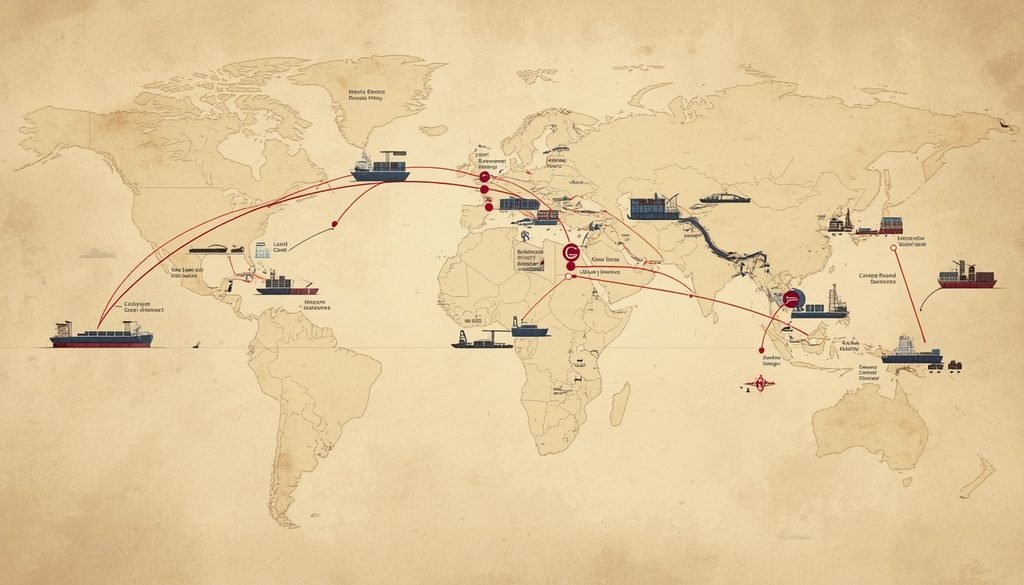
How AI Is Changing Global Trade
Artificial intelligence is becoming one of the most important technological forces affecting global commerce.
The most obvious impact can be seen in the physical products required to build AI infrastructure. Advanced processors, memory, servers, networking equipment and data-center components are moving through international supply chains at an increasing rate.
But AI’s influence goes beyond hardware.
Businesses are also using AI to analyze trade data, forecast demand, monitor suppliers, identify logistics risks and automate administrative processes.
A company managing thousands of international shipments, for example, may need to evaluate supplier reliability, transportation costs, customs requirements, currency movements and changing tariffs. Traditionally, these decisions required large teams and significant amounts of manual analysis.
AI can process these variables much faster.
| Area | Traditional Approach | AI-Enabled Approach |
|---|---|---|
| Demand forecasting | Historical spreadsheets | Predictive models |
| Supplier analysis | Manual research | Automated risk scoring |
| Shipment tracking | Periodic updates | Real-time monitoring |
| Tariff analysis | Manual classification | AI-assisted analysis |
| Inventory planning | Fixed assumptions | Dynamic forecasting |
| Risk management | Reactive | Predictive |
| Trade documentation | Manual processing | Intelligent automation |
| Route planning | Static optimization | Dynamic optimization |
This does not mean AI will completely replace trade professionals. Instead, it changes how they make decisions.
A procurement manager can spend less time collecting information and more time deciding which supplier strategy makes sense. A logistics team can identify potential delays earlier. A finance team can model how tariffs could affect margins before committing to a transaction.
AI is therefore becoming part of the decision infrastructure behind global trade.
AI-Related Goods Are Becoming a Major Trade Driver
One of the most important developments in global trade is the rapid growth of AI-related hardware.
The construction of AI infrastructure requires enormous quantities of advanced technology. Data centers require processors, servers, networking equipment, memory, cooling systems, power systems and construction materials.
This creates a ripple effect across international trade.
McKinsey’s 2026 research found that AI-related trade grew close to 40% in 2025, significantly faster than overall global trade. The company estimated that AI-related goods accounted for around one-third of global trade growth.
UNCTAD has also reported that AI-related products were a major source of merchandise trade growth, while broader trade momentum remained comparatively modest.
This creates an unusual situation.
AI is not only a software revolution. It is also becoming a global manufacturing and trade phenomenon.
The AI economy depends on international networks involving semiconductor manufacturing, advanced packaging, data-center equipment, cloud infrastructure, electricity generation and logistics.
| AI Infrastructure Component | Trade Impact |
|---|---|
| Semiconductors | Increased cross-border demand |
| GPUs and accelerators | Higher technology trade |
| Servers | Growth in manufacturing and exports |
| Networking equipment | Expansion of data-center supply chains |
| Cooling systems | New industrial demand |
| Power equipment | Increased infrastructure investment |
| Data centers | Regional construction and equipment demand |
| Critical minerals | Greater strategic importance |
This creates opportunities for countries that can become important suppliers of AI infrastructure.
It also creates new vulnerabilities.
If semiconductor manufacturing is concentrated in a limited number of locations, geopolitical disruptions can have global consequences. If tariffs are imposed on critical components, the cost of AI infrastructure can increase.
AI and global trade are therefore becoming increasingly interconnected.
How Tariffs Are Reshaping Global Supply Chains
Tariffs have always been part of trade policy. I see how the importance of tariffs has grown a lot lately.
A tariff changes the economics of importing a product. If a company imports a component for $100 and faces an additional tariff, the effective cost can increase substantially.
Businesses then have several choices. They can absorb the cost, increase prices, reduce margins, change suppliers or move part of their production.
The choice depends on the product on what customers want on how easy it’s to find a supplier and on how well the company can change its supply chain.
UNCTAD has warned that rising tariffs add uncertainty and can disturb sourcing and investment decisions. The analysis also says that diversifying suppliers and moving production are ways to respond to shifts, in geopolitics and trade policy.
| Tariff Pressure | Possible Business Response |
|---|---|
| Higher import costs | Find alternative suppliers |
| Reduced margins | Adjust pricing |
| Supplier concentration | Diversify sourcing |
| Market access restrictions | Build regional production |
| Uncertain tariff policy | Increase scenario planning |
| Higher logistics costs | Optimize routes |
| Regulatory complexity | Invest in compliance technology |
The important point is that tariffs do not simply affect customs costs.
They can influence the entire structure of a company’s supply chain.
A manufacturer may decide that paying a higher unit cost from a second supplier is preferable to depending entirely on one country. A retailer may change sourcing markets. A technology company may build additional manufacturing capacity closer to its customers.
This is why tariffs are becoming a supply chain issue rather than simply a trade policy issue.
The Shift From Efficiency to Resilience
For years, businesses prioritized efficiency.
The goal was to reduce inventory, lower transportation costs and source products from the most cost-effective locations. That approach created highly optimized supply chains, but optimization sometimes came at the expense of resilience.
A disruption at one supplier could affect hundreds of downstream businesses.
The COVID-19 pandemic demonstrated this vulnerability, but subsequent geopolitical tensions, shipping disruptions and tariff changes have reinforced the lesson.
Today, businesses increasingly want supply chains that can absorb shocks. This does not mean abandoning efficiency. It means finding a balance between efficiency and resilience.
A company might accept a slightly higher procurement cost in exchange for having two or three qualified suppliers instead of one. It might maintain additional inventory for strategically important components. It might establish production capacity in multiple regions.
The new objective is therefore:
Optimize for cost, but manage for risk.
McKinsey’s supply chain research has shown how tariffs have become a major concern for supply chain leaders, with companies adjusting priorities in response to changing trade conditions.
Supply Chain Diversification Is Becoming a Priority
Supply chain diversification is one of the clearest characteristics of the new global trade environment.
Instead of relying on one country or supplier, companies are increasingly building networks.
For example, a business might source components from China, assemble products in Vietnam, maintain distribution centers in Europe and North America, and sell to customers across several markets.
This creates additional complexity, but it also reduces dependence on a single location.
The concept is sometimes described as a China+1 strategy, although modern supply chain diversification is broader than simply moving production from China to another country.
Companies are considering manufacturing and sourcing locations based on cost, skills, infrastructure, trade agreements, political stability and proximity, to customers.
| Supply Chain Strategy | Main Objective |
|---|---|
| China+1 | Reduce geographic concentration |
| Nearshoring | Move production closer to customers |
| Friend-shoring | Prioritize strategically aligned markets |
| Regionalization | Build regional supply networks |
| Multi-sourcing | Reduce supplier dependency |
| Vertical integration | Increase control over critical inputs |
UNCTAD reports that geopolitical tensions, industrial policy and technology are driving supplier diversification and production relocation closer to end markets.
This could lead to a world where global supply chains remain international but become less centralized.
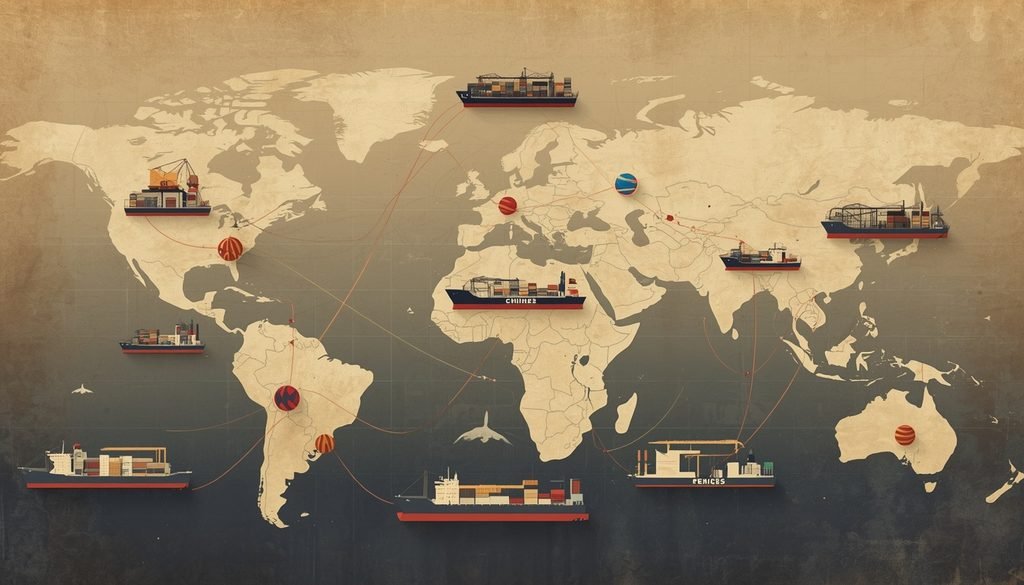
China, ASEAN, India and the Changing Trade Map
The geography of global trade is changing.
China remains one of the world’s most important manufacturing and trading economies, but companies are increasingly diversifying production and sourcing.
ASEAN economies are becoming important beneficiaries of this shift.
McKinsey’s 2026 analysis showed that Southeast Asia strengthened its role in the global manufacturing sector, while India bottomed out in select areas. In addition, it was observed that U.S. procurement shifted to alternative suppliers as U.S.-China trade changed.
This does not mean China is disappearing from global supply chains.
Instead, China’s role is evolving.
China continues to supply large quantities of components, industrial machinery and manufacturing inputs, while other countries are increasing their roles in assembly and final production.
India is also becoming increasingly important in areas such as electronics manufacturing and technology-related production.
ASEAN countries, meanwhile, are benefiting from supply chain diversification and their proximity to major Asian manufacturing networks.
The result is a more distributed manufacturing landscape.
The Role of Technology in Modern Supply Chains
Technology is becoming essential to managing this increasingly complex environment.
A modern international supply chain can involve thousands of suppliers, multiple transportation modes, customs processes, currencies, regulations and customer markets.
Without digital systems, managing this complexity becomes difficult.
Cloud platforms provide centralized access to supply chain information. AI can analyze large datasets. Internet-connected sensors can provide shipment information. Digital trade platforms can simplify documentation.
Together, these technologies can create a more transparent supply chain.
| Technology | Supply Chain Application |
|---|---|
| Artificial intelligence | Forecasting and risk management |
| Machine learning | Demand prediction |
| Cloud computing | Data sharing |
| IoT | Shipment monitoring |
| Blockchain | Transaction and document verification |
| Digital twins | Scenario modeling |
| Predictive analytics | Disruption forecasting |
| Automation | Documentation and workflow management |
The value of these technologies becomes particularly clear during disruption.
If a shipping route becomes unavailable, a digitally connected supply chain can evaluate alternative routes and suppliers faster than a system dependent on manual processes.
How AI Helps Businesses Manage Trade Risks
AI can play a particularly important role in risk management.
A global company might have to keep track of different factors. These include how well suppliers perform, prices of goods, shipping conditions, political changes, tariffs, currency shifts and how much customers want products.
People can look at this data. Understand it.. Going through all of it by hand takes too much time and effort. AI systems can watch over amounts of data all the time. They can pick up on things that seem out of the ordinary.
For instance an AI tool used in supply chain management might notice that a supplier is delivering goods later than before. At the time it could spot rising transport fees from that area.
Of waiting for a big problem to happen the company can act early. It can look into suppliers and make changes before things get worse. AI can also support scenario planning.
A company could ask:
What happens to our margins if a 15% tariff is introduced on a major component?
Another scenario could evaluate what happens if a supplier becomes unavailable. Another could compare the financial impact of moving production to another country.
The value is not simply automation. It is faster decision-making.
Global Trade and the Rise of Digital Infrastructure
Physical trade depends increasingly on digital infrastructure.
A container may travel across several countries, but the information associated with that shipment can move across dozens of systems. Invoices, purchase orders, customs documents, tracking information, compliance records and payment instructions all require digital connectivity.
This is creating demand for technologies that connect trade participants.
Banks, logistics companies, manufacturers, marketplaces and technology providers are increasingly building digital platforms around international commerce.This also creates opportunities for financial technology.
Trade finance, cross-border payments, foreign exchange and supply chain finance can all benefit from better data and automation.
The traditional trade process can involve multiple intermediaries and manual documentation.
Digital systems can make these processes faster and more transparent.
The Growing Importance of Trade Data
Data is becoming one of the most valuable resources in modern global trade. Companies need accurate information about suppliers, customers, markets, tariffs, transportation and regulations.
The challenge is that trade data is often fragmented. A procurement team may have supplier data in one system, logistics data in another and financial information somewhere else.
AI becomes more useful when these datasets can be connected. A company with integrated trade data can create a clearer picture of its international operations.
| Data Type | Business Value |
|---|---|
| Supplier data | Vendor risk analysis |
| Customs data | Compliance management |
| Shipment data | Logistics optimization |
| Pricing data | Margin management |
| Tariff data | Cost forecasting |
| Customer data | Demand forecasting |
| Geopolitical data | Risk assessment |
| Currency data | Financial planning |
This is one reason digital transformation is becoming closely connected to trade resilience.
Tariffs, Inflation and Business Costs
Tariffs can affect more than the businesses that initially pay them. When import costs increase, companies may absorb the additional expense, raise product prices, change suppliers, redesign products, or accept lower profit margins. These effects can eventually move through the supply chain and influence retailers and consumers.
This makes tariff analysis especially important for businesses with international supply chains. Companies need to understand not only the tariff rate but also its potential impact on their overall cost structure, pricing, suppliers, and profitability.
The Impact on Small and Mid-Sized Businesses
Small and mid-sized businesses often face greater challenges because they may depend on a limited number of suppliers, countries, or logistics providers. They may also have fewer resources for customs compliance, tariff analysis, and geopolitical risk management.
Technology can help address this challenge. Affordable cloud platforms and AI-powered tools can support smaller businesses by helping them monitor shipment costs, track regulatory changes, compare suppliers, and identify potential supply chain risks.
The growing availability of these technologies could make advanced trade and supply chain capabilities more accessible, helping smaller businesses respond more effectively to changes in global commerce.
How Financial Services Are Supporting the New Trade Environment
The changing structure of global trade also creates opportunities for banks and fintech companies.
International commerce requires money to move between businesses, countries and currencies. Trade finance helps companies manage the gap between buying goods and receiving payment. Supply chain finance can provide liquidity to suppliers. Cross-border payment technology can reduce friction in international transactions.
As supply chains become more distributed, these financial services become increasingly important. Businesses may need financing for multiple suppliers, additional inventory or new manufacturing facilities.
They may also need better foreign-exchange management as they transact across more markets.
| Financial Service | Role in Global Trade |
|---|---|
| Trade finance | Supports international transactions |
| Supply chain finance | Provides supplier liquidity |
| Cross-border payments | Enables international settlement |
| Foreign exchange | Manages currency exposure |
| Working capital finance | Supports inventory and operations |
| Insurance | Protects against selected trade risks |
| Digital banking | Simplifies international financial management |
This is where the future of global trade intersects with fintech.
As trade becomes more digital, financial services are increasingly being embedded directly into commercial workflows.
What Businesses Should Do Next
Businesses cannot control global tariffs, geopolitical conflicts, or international regulations, but they can control how prepared they are.
The first step is to understand supply chain concentration. Companies should identify critical suppliers and assess how easily they could be replaced if disruption occurs.
The second step is scenario planning. Instead of relying on a single forecast, businesses should prepare for different potential outcomes.
The third step is improving supply chain visibility. Accurate and timely data can help companies identify risks before they create major disruption.
The fourth step is selective diversification. Not every supplier needs to be replaced. Businesses should focus diversification efforts on suppliers, components, markets, and relationships where disruption could have the greatest financial impact.
Finally, businesses should use technology and data to improve decision-making, monitor risks, and respond more effectively to changing global conditions.
| Business Priority | Strategic Action |
|---|---|
| Supplier risk | Build multi-source networks |
| Tariff exposure | Run cost scenarios |
| Logistics risk | Develop alternative routes |
| Data visibility | Connect supply chain systems |
| AI adoption | Automate forecasting and analysis |
| Financial risk | Strengthen cash-flow planning |
| Compliance | Digitize trade documentation |
| Market risk | Diversify customer markets |
The goal is not to build a completely disruption-proof supply chain. That is unrealistic.
The goal is to build a supply chain that can adapt quickly when conditions change.
Global Trade Trends to Watch
Several developments are likely to shape the next stage of global trade.
1. AI-Driven Trade Growth
AI infrastructure will continue to influence demand for semiconductors, servers, networking equipment and other technologies. The WTO reported that strong AI-related trade helped support global merchandise trade in early 2026.
2. Supply Chain Rationalization
Businesses are likely to continue developing regional production and sourcing networks.
3. Tariff Volatility
Companies will increasingly need to plan for changing trade policies rather than assuming that tariff conditions will remain stable.
4. Supplier Diversification
Businesses will continue moving away from excessive dependence on individual suppliers or countries.
5. Digital Trade
Electronic documentation, digital payments and cloud-based trade platforms will become more important.
6. AI-Powered Supply Chain Management
AI will increasingly support forecasting, procurement, inventory management and risk monitoring.
7. Trade Finance Innovation
Banks and fintech companies will have opportunities to build more flexible financial products around increasingly complex trade networks.
8. Geopolitical Risk Management
Geopolitical analysis will become more closely integrated into procurement and supply chain decisions.
The Future of Global Trade
The future of global trade will probably not be defined by the end of globalization. Instead, it is likely to be shaped by a more flexible and resilient form of globalization.
Companies will continue buying and selling across borders, but supply chains may become more diversified. Businesses could rely on more suppliers, multiple manufacturing locations, and stronger regional distribution networks.
AI is expected to accelerate this transformation by helping companies analyze trade data, forecast demand, monitor supply chains, and identify potential risks. At the same time, the physical infrastructure required to build AI systems will become an increasingly important part of international trade.
Tariffs will continue influencing sourcing decisions, while geopolitical uncertainty will encourage businesses to balance efficiency with resilience.
The global supply chains of the future may therefore look very different from the highly centralized networks of previous decades. They are likely to become more digital, data-driven, diversified, and adaptable to change.
Conclusion:
The new era of global distribution is created through 3 effective forces: AI, pricing and chain transformation delivers.
The AI era is creating a new demand for infrastructure and better productivity. Tariffs are changing the economics of sourcing worldwide. Geopolitical uncertainty is prompting businesses to diversify suppliers and reconsider where products are made.
These forces are developing a more complex global buying and selling environment, yet they are also increasing opportunities.
Companies that can integrate time with flexible distribution chain strategies may be in a better position to respond to disruption. Businesses that rely entirely on historical sourcing models, moreover, may discover that it is increasingly difficult to compete when price lists, politics, and geopolitical conditions trade at a rapid pace.
The biggest lesson is that the worldwide exchanges no longer really rely on the cheapest way to move goods from one to another.
It is ready to build a community that can adapt, anticipate, budget and respond. AI can make sense. Digital structures can provide visibility. Financial age can provide liquidity. and different distribution chains offer flexibility.
Together, these efficiencies define subsequent liquidity in international trade.
Worldwide exchanges are honestly not going to have the success of companies with floor fees. This will increasingly come down to companies that can catch the business early, make faster choices and build delivery chains with enough bends to evolve against an uncertain global.
Frequently Asked Questions
1. What is changing in global trade?
Global trade is being reshaped by AI, tariffs, geopolitical tensions, supply chain diversification, digital technology and changing regulations. Companies are increasingly balancing cost efficiency with resilience and risk management.
2. How is AI affecting global trade?
AI is affecting global trade in two major ways. First, demand for AI-related products such as semiconductors, servers and networking equipment is increasing international trade. Second, businesses are using AI for forecasting, supplier management, logistics optimization and risk analysis.
3. How are tariffs affecting supply chains?
Tariffs can increase import costs and encourage businesses to find alternative suppliers, move production, redesign products or change sourcing strategies. This can result in longer-term changes to global supply chain structures.
4. Why are companies diversifying their suppliers?
Companies are diversifying suppliers to reduce dependence on a single country, supplier or trade route. Diversification can improve resilience when tariffs, geopolitical disruptions or logistics problems affect a particular market.
5. Is globalization ending?
Globalization is not necessarily ending. Instead, global commerce is becoming more diversified and strategically managed. Businesses are still trading internationally but are increasingly considering geopolitical risk, resilience and regional production.
6. Which countries are benefiting from supply chain diversification?
Several emerging manufacturing hubs are gaining attention, particularly economies in ASEAN and India. McKinsey’s 2026 research highlights the expanding role of Southeast Asia and India’s gains in selected sectors.