
In Present Day business environments, operations are becoming increasingly complicated. The goal of any company is to produce goods efficiently, lower expenses, and keep high standards of customer satisfaction. Nevertheless, traditional approaches to management are not able to meet new requirements. Thus, the application of intelligent solutions and automation processes significantly contribute to the evolution of the supply chain.
Intelligent systems stimulate companies to change their tactics because they can process vast amounts of information, anticipate customer demand, and facilitate better decisions. Moreover, automation processes decrease manual labor and ensure improved efficiency. Consequently, the evolution of the supply chain through the application of innovative technologies becomes apparent.
A management strategy is not just about transferring goods from point A to point B. It is crucial to carefully consider all the aspects of the process, such as planning, procurement, manufacturing, and delivery. Modern technological solutions allow for improving every step.
Understanding the System
An operational system in modern times encompasses all the actions taken in procurement, manufacturing, warehousing, and distribution. All these actions must be coordinated so that tasks will be performed effectively. The result of this alignment will be improved productivity and results.
The operational structure ensures efficient coordination and visibility so that the organization can manage its performance better and be able to react to any changes that occur. This ability helps achieve better results and meets customers’ requirements.
Today, there are digital technologies that can improve this process even further through insights, automation, and data-driven decision-making.
Core Components
- Procurement and Sourcing
- Manufacturing Processes
- Inventory Management
- Transportation
- Distribution
Traditional vs Smart Systems
| Feature | Traditional Approach | Smart Approach |
|---|---|---|
| Decision Making | Manual | Data-driven |
| Speed | Slower | Faster |
| Accuracy | Moderate | High |
| Flexibility | Limited | High |
The Role of Intelligent Technologies
Smart technologies have really changed how companies do business. They help companies look at a lot of data and find patterns. This means companies can make decisions and get more work done.
One of the things about smart technologies is that they can predict what will happen. Companies can see what people will want and plan for it. This reduces the chance of things going wrong. Makes business run more smoothly.
Main Advantages
- decision-making
- Real-time information
- Forecasting abilities
- operating costs
- Higher efficiency
Smart technologies are very useful for companies. They help companies make decisions and work well. Intelligent technologies like these are very important, for business. The role of technologies is to make business easier and better. Intelligent technologies do this by helping companies use data to make decisions.
Optimization Techniques for the Supply Chain
The supply chain optimization techniques aim at enhancing efficiency and minimizing costs. The techniques comprise analysis and finding areas of improvement. Companies employ technology to increase efficiency.
The optimization techniques include improved inventory management and efficient delivery process. They also entail minimizing wastage and maximizing resource utilization. The effects of these techniques are increased efficiency.
Adoption of AI and automation ensures efficient optimization. The techniques make organizations capable of responding to changes and maintaining efficiency.
Techniques for Optimization
- Process automation
- Data-driven decision making
- Inventory optimization
- Route optimization
- Supplier management
Supply Chain Optimization Methods
| Method | Purpose | Benefit |
|---|---|---|
| Automation | Reduce manual work | Efficiency |
| Analytics | Data insights | Better decisions |
| Inventory Control | Manage stock | Cost reduction |
| Logistics Planning | Improve delivery | Faster service |
AI in Demand Forecasting
It is important to forecast demand in the supply chain process since it enables organizations to plan and make decisions. This will allow the organization to anticipate demand for its products.
AI in demand forecasting can enhance accuracy since it uses data from the past together with other variables like seasonality and consumer behavior to predict demand effectively.
Benefits of Demand Forecasting
- Inventory planning
- Minimizing wastage
- Customer satisfaction
- Efficiency
- Costs saving
Automation in Supply Chain
Automation is one of the essential elements of increasing the effectiveness of the supply chain. With its help, manual procedures can be minimized, and operations will become faster. In other words, productivity will increase.
Automation is utilized in warehouse management and order processing. Such an approach guarantees greater precision and fewer mistakes. As a result, performance will be enhanced.
The synergy between automation and artificial intelligence enables creating an extremely effective system that will handle all the complex tasks easily.
Advantages of Automation
- Increased speed
- Accuracy
- Cost reduction
- Efficiency
- Scalability
Significance of Real-Time Data
Real-time data is really important for supply chains that we have today. We can get information away, from real-time data and this helps us make good decisions.
Companies can use real-time data to keep track of deliveries and manage the things they have in stock. This makes things work better and reduces the chances of something going wrong.
Factors
- We need to make decisions right away with real-time data
- We can see everything that is happening with real-time data
- Real-time data helps us work more efficiently
- Real-time data reduces the risks that companies face
Logistics in Supply Chain Management
Logistics forms an important component of supply chain management systems. It refers to transport and delivery of products. Effective logistics guarantees timely delivery of the products.
The use of AI optimizes transport routes, thus reducing costs and improving efficiency. This also boosts customer satisfaction.
Important aspects
- Effective transportation
- Reducing costs
- Timely delivery
- Improved planning
Logistics Optimization
| Aspect | Benefit |
|---|---|
| Route Planning | Faster delivery |
| Cost Control | Lower expenses |
| Tracking | Better visibility |
Risk Management in Supply Chain
Managing risks is crucial for building a supply chain.
Today businesses face uncertainties like delays and supplier problems. These risks can stop operations. Make customers unhappy if not handled well. Companies must find risks early. Have plans ready.
Key Points
- Identify risks on
- Have plans, in place
- Regularly check operations
- Use data to make decisions
- Make supply chains more flexible
Inventory Management
Effective inventory management is responsible for maintaining optimal stock levels. This prevents any shortage and surplus problems. This enhances efficiency.
AI technology assists in keeping real-time records of inventory. This facilitates better planning and management. Additionally, costs are reduced.
Important Points
- Stock management
- Cost savings
- Planning
- Efficiency
The Digital Transformation of the Supply Chain
There have been numerous transformations in the way business entities manage their supply chain operations. These transformations involve the use of technology to facilitate smoothness and efficiency in the activities carried out within such a business entity. The company is shifting from the activity-based approach and adopting the digital platform, which allows them to be in control and provide an overview of the activities taking place.
This transformation has become vital for organizations that wish to remain competitive within their industries.
Points to Consider
- Utilize digital tools in managing operations
- Receive real-time updates regarding operations
- Make sound decisions by making use of the necessary information
- Efficient operation
- Improved coordination within the supply chain
Future of AI in Supply Chain
The future of AI in supply chain management is really looking good. New things are coming out all the time. These new things will make supply chain management work better.
AI in supply chain management will help people make choices and will automate a lot of tasks. This is going to change the way supply chain management works. Companies need to change with the times to stay ahead of the game.
Key Points
- Advanced analytics for AI in supply chain management
- Increased automation in AI in supply chain management
- Better forecasting with the help of AI in supply chain management
- Improved efficiency in AI, in supply chain management
Future Trends
| Trend | Impact |
|---|---|
| AI Growth | Smarter systems |
| Automation | Efficiency |
| Data Analytics | Better insights |
Supply Chain Problems and Solutions
There are a lot of issues that supply chains have to deal with these days. Supply chains have to deal with delays, rising costs and changes in demand. It is really important to find ways to solve these supply chain problems.
New technology gives us ways to solve these supply chain problems. Artificial intelligence helps us predict problems and plan for the future. Automation reduces mistakes. Helps us get more work done.
Companies need to be ready to think. That means they have to keep an eye on things and make improvements all the time.
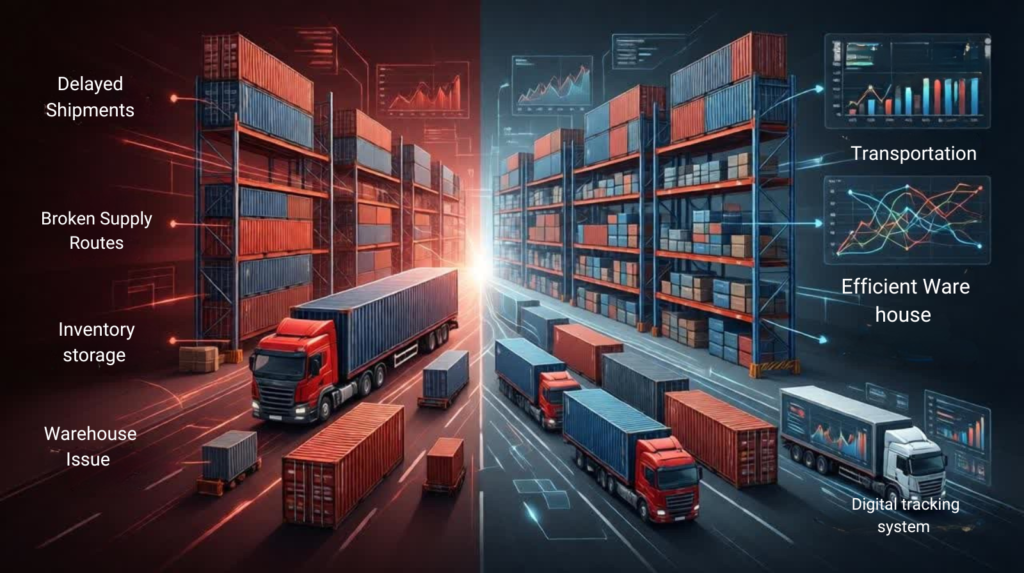
Problems Faced
- Uncertainty of demand for products
- operational expenses
- Disruptions in the supply chain process
- Visibility issues in the supply chain
- Inefficiency, in the supply chain
Challenges and Solutions
| Challenge | Impact | Solution |
|---|---|---|
| Demand Fluctuation | Stock issues | AI forecasting |
| High Costs | Reduced profit | Optimization |
| Delays | Customer dissatisfaction | Automation |
Conclusion
In the world we live in today businesses need more than the basics to stay ahead. They need systems that’re smart and can change and get better over time. If businesses only use the ways of doing things it can slow them down.. If they use new and modern ways it can make things run more smoothly and be more efficient.
Using Artificial Intelligence and automation can make a difference. It means people do not have to do much work by hand and it helps get things right. It also helps teams make decisions faster. This saves businesses time and money. It also makes customers happier. When everything works together the results are more consistent and reliable.
At the end of the day it is not about using technology. It is about using Artificial Intelligence and automation in the right way. Businesses that always try to get better and are open, to change will always be one step ahead. With the way of thinking and the right tools building a system that works well and can grow with the business becomes much easier. Businesses that use Artificial Intelligence and automation will find it easier to build a system that’s efficient and scalable.
FAQS
1. Define the concept of the supply chain system.
The supply chain system refers to the whole process of product movement from the supplier to the consumer. The processes include sourcing, manufacturing, warehousing, and distribution.
2. Explain how AI can be useful in managing the supply chain.
AI can be useful because it will analyze available information, make predictions about customer demand, and improve decision-making for companies that implement AI in their supply chain management system.
3. What part does automation take in the supply chain systems?
Automation takes care of tasks that require a lot of time for employees. These tasks include order entry and updating stock.
4. How can businesses make their supply chain work better?
Businesses can make their supply chain work better by using tools that look at the numbers making processes simpler reducing the time things get delayed and using technology like Artificial Intelligence and automation.
5. What are the good things about using Artificial Intelligence in supply chain operations?
The good things, about using Artificial Intelligence in supply chain operations are that it helps businesses predict what will happen better it makes things more accurate it saves businesses money it helps them make decisions faster. It makes the whole supply chain work better.
6. What are some common problems that businesses have with their supply chain?
Some common problems that businesses have with their supply chain are that people want things at different times things get delayed it costs a lot of money businesses do not know what is going on and the processes are not very good.