
Skip to content
SUBSCRIBE
  • Technology
    Key Insights into QSRs’ Affordability and Profitability Balancing Act — And How To Successfully Bridge Gaps
    Technology
    Key Insights into QSRs’ Affordability and Profitability Balancing Act — And How To Successfully Bridge Gaps
    January 30, 2026
    Saurav Dhawale
    No posts found
    Why Cloud Identity Security and Why It Seems So Hard
    Technology
    Why Cloud Identity Security and Why It Seems So Hard
    download (36)
    Technology
    Google Cloud VMware Engine Supercharged With Google Cloud NetApp Volumes
    Omdia Universe: Email Security,
    Technology
    Omdia Universe: Email Security, 2024
    No posts found
    View All
  • HRTech
    Top 5 Critical Capabilities of a Detection and Response Platform
    Hrtech
    Top 5 Critical Capabilities of a Detection and Response Platform
    January 22, 2026
    Saurav Dhawale
    No posts found
    Navigating the Paths of Risk: The State of Exposure Management in 2024
    Hrtech
    Navigating the Paths of Risk: The State of Exposure Management in 2024
    Screenshot-2026-01-30-190621
    Hrtech
    Unlocking Merchant Growth: Building a Payment Roadmap for Success
    Why IT struggles with innovation and what to do about it:
    Hrtech
    Why IT struggles with innovation and what to do about it:
    No posts found
    View All
  • Finance
    lucid-origin_Deep_Reddish_AI_Fraud_Detection_Prompt_Create_a_unique_vintage-modern_banking_cy-0
    Finance Finance 2025
    AI Fraud Detection: How Financial Institutions Stay Ahead of Cyber Threats
    August 14, 2026
    ailcia sierra
    No posts found
    download 85
    Finance
    Wie sich der ROI mit Slack verdreifachen lsst
    Unlock Enhanced Property Tax Compliance Strategies with Aberdeen’s Latest Insights!
    Finance
    Unlock Enhanced Property Tax Compliance Strategies with Aberdeen’s Latest Insights!
    Views from the c-suite: why endpoint management is more critical than ever before
    Finance
    Views from the c-suite: why endpoint management is more critical than ever before
    No posts found
    View All
  • Marketing
    Secure Transformation: Replacing Remote Access
    Marketing
    Secure Transformation: Replacing Remote Access VPN with Prisma Access
    January 21, 2026
    Saurav Dhawale
    No posts found
    Cracking Tomorrow’s CX Code
    Marketing
    Cracking Tomorrow’s CX Code
    lucid-origin_Image_Prompt_Deep_Reddish_Agentic_Marketing_Tools_Theme_A_highly_creative_deep_r-0
    Marketing
    10 Best Agentic Marketing Tools to Automate Smarter Campaigns
    5 Ways Customer Loyalty is Evolving
    Marketing
    5 Ways Customer Loyalty is Evolving
    No posts found
    View All
  • Resources
    • Web Development
    • Technology 2025
    • Supply Chain
    • Storage
    • Security
    • Networking And Communication
    • MSP
    • Library
    • IT Security
    • IT Management
    • IT Infrastructure
    • IOT
    • Global Trade
    • Stock Market
    • Insurances
    • Banking
    • Finance 2025
    • ERP
    • Ecommerce
    • Ebook
    • Digital Advertising
    • Data Security
    • Data Management
    • Content Marketing
    • Cloud Migration
    • Cloud Computing
    • Big Data
    • B2B Marketing
    • Audit And Compliance
    • Artificial Intelligence
    • Application Development
    • API
    • Analytics
    • Abm Marketing
  • Contact
  • About
    • Privacy Policy
    • Terms of Use
    • Cookies Notice
  • work-with-us
    • Advertise With-Us
  • Technology
    photo (1)
    Technology
    How Real-World Brands Are Succeeding With Agentic AI
    June 26, 2025
    Saurav Dhawale
    No posts found
    Measurement Primer for Brands
    Technology
    Measurement Primer for Brands
    img
    Technology
    8 Benefits of a Backup Service for Microsoft 365
    Gemini_Generated_Image_xbm9oyxbm9oyxbm9 (1)
    Ebook
    EBooks for Gen Z: Engaging Content for Short Attention Spans
    No posts found
    View All
  • HRTech
    The Total Economic Impact Of Equinix Digital Services
    Hrtech
    The Total Economic Impact Of Equinix Digital Services
    January 19, 2026
    Saurav Dhawale
    No posts found
    Comprehensive Student Management – Stream line Administration and Enhance Student Success
    Hrtech
    Comprehensive Student Management – Streamline Administration and Enhance Student Success
    Uncover Hidden Savings and Boost the Bottom line in F&B Manufacturing
    Hrtech
    Uncover Hidden Savings and Boost the Bottom line in F&B Manufacturing
    Tactical Buyers Guide: All-Flash SAN Storage for the Hybrid Cloud
    Hrtech
    Tactical Buyers Guide: All-Flash SAN Storage for the Hybrid Cloud
    No posts found
    View All
  • Finance
    download 53
    Finance
    Next Generation Firewall Buyer's Guide
    July 9, 2025
    Saurav Dhawale
    No posts found
    NetApp All-SAN Array – Data Availability and Integrity with the NetApp ASA
    Finance
    NetApp All-SAN Array – Data Availability and Integrity with the NetApp ASA
    COMPREHENSIVE GUIDE TO SECURITY OPERATIONS
    Finance
    Comprehensive Guide to Security Operations
    Modernize Customer Experiences
    Finance
    Modernize Customer Experiences: A Salesforce for State and Local Government
    No posts found
    View All
  • Marketing
    Tools designed for security could be your biggest cybersecurity threat
    Marketing
    Tools Designed for Security Could Be Your Biggest Security Threat
    January 28, 2026
    Saurav Dhawale
    No posts found
    Securing Operations for Consumer Packaged Goods
    Marketing
    Securing Operations for Consumer Packaged Goods
    Why Traditional Marketing Models Are Failing Without Marketing Technology
    Marketing
    Why Traditional Marketing Models Are Failing Without Marketing Technology
    How to Measure Behavior
    Marketing
    How to Measure Behavior
    No posts found
    View All
  • Resources
    • Web Development
    • Technology 2025
    • Supply Chain
    • Storage
    • Security
    • Networking And Communication
    • MSP
    • Library
    • IT Security
    • IT Management
    • IT Infrastructure
    • IOT
    • Global Trade
    • Stock Market
    • Insurances
    • Banking
    • Finance 2025
    • ERP
    • Ecommerce
    • Ebook
    • Digital Advertising
    • Data Security
    • Data Management
    • Content Marketing
    • Cloud Migration
    • Cloud Computing
    • Big Data
    • B2B Marketing
    • Audit And Compliance
    • Artificial Intelligence
    • Application Development
    • API
    • Analytics
    • Abm Marketing
  • Contact
  • About
    • Privacy Policy
    • Terms of Use
    • Cookies Notice
  • work-with-us
    • Advertise With-Us
Home » automation tools
Tag:

automation tools

Automation

How Is AI Used in Marketing Automation and Campaigns?

by ailcia sierra August 4, 2026
written by ailcia sierra

AI is changing the way companies do marketing fast by using marketing automation . This is especially true for things like making marketing campaigns work automatically and managing them. Companies are not just using people to do things or old automation tools. They are using AI systems to make marketing campaigns that’re smarter and work better.

Artificial Intelligence is used for lots of things like email marketing and ads on media. It is also used to group customers together. Make campaigns work better. Artificial Intelligence is changing how people who do marketing plan things make them happen and make them better. It helps companies understand what customers do what they might do next and give them the information at the right time.

Nowadays companies that use AI to make marketing campaigns work automatically are doing a lot better, than others. They are getting more people to pay attention turning people into customers and making more money from what they spend on marketing. Artificial Intelligence is really helping these companies in a way.

What Is AI in Marketing Automation?

AI in marketing automation is, about using machine learning and data to make marketing tasks easier and better.

Traditional automation uses set rules. Artificial Intelligence learns from data and gets better over time. It looks at how customers behave guesses what might happen and makes decisions without needing people to constantly tell it what to do.

What Is AI in Marketing Automation?

Here are some examples:

  • Personalized email campaigns
  • Automated ad targeting
  • Customer journey mapping
  • Content generation
  • Predictive analytics

AI makes marketing automation more dynamic, adaptive, and efficient.

How AI Is Used in Marketing Automation and Campaigns

1. Customer Segmentation and Targeting

One of the powerful uses of Artificial Intelligence in marketing is customer segmentation. Of grouping users based only on age, gender or location Artificial Intelligence analyzes deeper behavioral patterns such as browsing history, purchase behavior, engagement level and intent signals from the customers.

This allows marketers to create specific audience groups for the marketing campaigns. As a result the marketing campaigns become more relevant and effective leading to conversion rates for the business.

For example AI can identify customers who’re likely to purchase within a week and target them with personalized offers that are tailored to the customers.

2. Personalized Campaign Creation

AI enables hyper-personalization in the marketing campaigns. It helps brands deliver customized messages, product recommendations and offers based on individual user behavior of the customers.

Of sending the same email to all the customers, Artificial Intelligence tools can generate different versions of content tailored to each user segment of the customers.

This personalization increases engagement because the customers feel the content is relevant to their needs and interests as customers.

3. AI-Powered Email Marketing

Email marketing remains one of the effective digital channels and Artificial Intelligence has made it even more powerful for the marketers.

AI helps optimize the following things:

  • lines of the emails
  • Email timing for the customers
  • Content structure of the emails
  • Call-to-action placement in the emails

It also predicts the time to send emails to each user based on past behavior of the customers improving open rates and click-through rates for the emails.

AI can also automate email sequences for lead nurturing ensuring the customers receive the message at each stage of the journey, as customers.

4. Predictive Analytics for Campaign Performance

Predictive analytics is a deal for marketing automation. It looks at what happened in the past to figure out what will happen next.

Marketers can use it to predict things like:

  • Customer lifetime value
  • Conversion probability
  • Campaign success rate
  • Churn risk

This helps companies use their money wisely and focus on the things that will make them the most money.

Marketers do not have to guess. They can make decisions based on data and be more accurate.

How AI Is Used in Marketing Automation and Campaigns
5. Real-Time Campaign Optimization

Artificial intelligence is always watching how campaigns are doing and making changes on the fly to get results.

It can do things like:

  • Adjust ad bids
  • Change targeting parameters
  • Optimize creative elements
  • Pause underperforming ads

This means campaigns are always doing their best without someone having to check on them all the time.

It helps companies not waste money on ads and get a return on their investment.

6. Content Generation for Marketing Campaigns

AI tools can make a lot of marketing content quickly. This includes things like:

  • Ad copy
  • Social media posts
  • Outlines for blog posts
  • Content for landing pages
  • Descriptions of products

This saves time. Makes sure all the content looks the same.

Marketers can try out versions of content to see what works best.

7. AI in Social Media Marketing

Social media campaigns are getting better with intelligence. AI tools look at how people interacting with content and suggest the best ways to post it.

They also help with things like:

  • Scheduling posts automatically
  • Identifying trending topics
  • Analyzing engagement performance
  • Managing social interactions

This helps companies be seen and liked by more people on social media platforms.

AI makes social media marketing easier and more effective for companies, like Marketing Campaigns and AI.

AI vs Traditional Marketing Automation
FeatureTraditional AutomationAI-Powered Automation
Decision MakingRule-basedData-driven
PersonalizationLimitedAdvanced
OptimizationManualReal-time
Content CreationHuman-onlyAI-assisted
PredictionNot availablePredictive analytics

Benefits of AI in Marketing Automation

AI offers several advantages that improve overall marketing performance. One major benefit is increased efficiency. AI reduces manual workload by automating repetitive tasks, allowing marketers to focus on strategy and creativity.

Another benefit is improved personalization. Customers receive content that matches their interests, leading to higher engagement and conversions. AI also improves ROI by optimizing campaigns in real time and reducing wasted ad spend. Additionally, it enhances decision-making by providing actionable insights based on data.

Overall, AI helps businesses scale marketing efforts without increasing operational complexity.

Important Use Cases in Real-World Marketing

AI is widely used across different marketing channels.

In digital advertising, AI optimizes ad targeting and bidding strategies. In email marketing, it personalizes communication and improves open rates. In content marketing, it helps generate ideas and draft content faster.

Ecommerce businesses use AI to recommend products, while SaaS companies use it for lead scoring and customer onboarding. These use cases demonstrate how AI is becoming essential across industries.

AI-Powered Lead Scoring and Qualification

AI is really good at helping with lead scoring and qualification. It looks at how people behave what they do and what they are interested in to find the leads. This means that the sales and marketing people can focus on the leads that’re most likely to buy something, which makes everything more efficient and effective.

AI-Powered Lead Scoring and Qualification

Making Sense of the Customer Journey with AI

Understanding what the customer does is very important in marketing today. AI helps us see what the customer does by looking at all the places they interact with us like our website, emails, ads and social media. It finds the places where people stop interacting with us and helps us make those places better more people will buy something. This makes it easier for people to use our website and helps our marketing campaigns work better.

AI Chatbots are Good at Getting People Engaged

AI chatbots are becoming a part of marketing campaigns. They talk to people in time answer their questions suggest products and help them buy something. These chatbots work all the time, which means people can get help whenever they need it. We can respond to them faster. They also help us get leads from the conversations they have with people.

AI Makes Ad Creatives Better

AI is changing the way we make ads. It can make different versions of an ad and then see which one works best. This means we can make our ads better and better without having to do a lot of work. It makes our ads work efficiently and helps us get a better return on our investment.

AI Helps with Marketing Analytics and Reporting

AI makes it easier to understand marketing data. It looks at all the information. Makes reports and insights, for us. It finds patterns and trends. Helps us see where we can improve. Of having to look at a lot of spreadsheets we can get the information we need quickly which helps us make good decisions faster. AI and marketing analytics are a combination because AI helps us understand what the marketing data means.

Challenges of AI in Marketing Automation

There are some problems with using AI in marketing automation.

One big issue is data privacy. AI needs a lot of customer information to work well. So companies have to make sure they follow the rules about keeping customer data private.

Another problem is that AI tools do not always work well with computer systems. Many companies use systems that are not easy to fix.

There is also a risk of relying much on machines. If marketing becomes too automated it can lose the touch that humans bring. AI models need to be trained. Checked all the time to make sure they are accurate.

Future of AI in Marketing Automation

The future of marketing automation is closely tied to how AI develops. In the few years AI will get even smarter and more independent.

Here are some things we can expect:

  • automated marketing campaigns
  • AI-generated creative design systems
  • Personalized customer journeys in real-time
  • Voice-based marketing automation
  • Predictive campaign building

Marketing will become more efficient, personalized and based on data than before.

Companies that start using AI will have a big advantage, in reaching and converting customers.

Conclusion

AI is changing how marketing automation and campaigns work. It is making marketing faster smarter and more personalized.

AI is helping businesses improve performance at every stage of the marketing funnel. This includes customer segmentation, predictive analytics, time optimization and content generation.

As technology keeps evolving AI will become a part of every marketing strategy. Companies that adopt AI will be better positioned to increase engagement improve conversions and maximize ROI in the economy.


August 4, 2026 0 comment
0 FacebookTwitterPinterestEmail
Automation Tools
Automation

Best Automation Tools for Small Businesses (No Paid Ads Needed)

by ailcia sierra August 1, 2026
written by ailcia sierra

Running a business can be tough. You have to do everything from managing leads to following up with customers. This takes a lot of time. Small business owners often get stuck doing the things over and over again. These tasks take up a lot of time and energy.

The good thing is that you do not need to be a company to use automation. Now small businesses can use free automation tools to make their work easier save time and make money. You can do all of this without paying for ads or expensive software.

Automation is not about getting things done faster. It is about working in a way. When you use automation correctly your small team can handle tasks that you do every day. You can talk to your leads regularly track how you are doing and focus on things that help your business grow. The best thing is that you do not need a lot of money or to be good with technology to use automation.

In this guide we will talk about the free automation tools for small businesses like yours. We will show you how to use each tool step by step. We will give you examples of businesses that are using these tools. We will also give you tips on how to make automation workflow for you. By the time you finish reading this guide you will know how to set up automated workflows be more productive and do manual work. You can do all of this without spending any money on paid tools.

We will explore automation tools, for small businesses. We will describe how to use each free automation tool. We will provide examples of businesses using these free automation tools. We will share tips to make these free automation tools work for your business.

Why Small Businesses Should Automate

Why Small Businesses Should Automate

Automation is not something that small businesses can just have if they want to. It is something that they really need to have if they want to grow in a way that will last. Here is why Small Businesses Should Automate:

  • Time-Saving: Small Businesses can automate tasks like sending follow-up emails to customers updating records and scheduling social media posts for Businesses. This gives Businesses back hours of work that they can use for other things.
  • Accuracy: When Small Businesses automate tasks, they can be sure that every task will happen on time and will be done correctly which means there will be mistakes made by people.
  • Improved Productivity: When tasks are automated for Small Businesses, the teams that work for Businesses can focus on work that is creative and involves making plans instead of just doing the same tasks over and over.
  • Cost-Effective Growth: There are tools that Small Businesses can use for free that can handle tasks that Small Businesses would otherwise have to hire more people to do or buy expensive software to do.
  • Scalable Processes: As Small Businesses grow and get bigger the automated systems that Small Businesses have in place can handle the increased amount of work without needing any effort from Small Businesses.

Small Businesses that use automation can stay competitive with businesses respond faster to customers of Small Businesses and focus on the areas of their business that will help them grow in the long run instead of just focusing on the day-, to-day work of Small Businesses.

Benefits of Using Automation Tools:

BenefitHow It Helps
Saves TimeAutomates repetitive tasks like emails and notifications
Improves AccuracyReduces human errors in tasks like data entry
Boosts ProductivityFrees employees to focus on revenue-generating work
Enhances Customer ExperienceEnsures timely responses and follow-ups
Scalable OperationsHandles growing business processes effortlessly

How to Choose the Right Automation Tool?

To pick the automation tool you need to know what your business needs. Think about this:

  • What tasks take up most of your time?
  • What tasks do you do over and over that always follow the rules?
  • Where do you make mistakes the most?.
  • What work can be automated without needing to be a tech expert?

When you figure out these things you can look at the AUTOMATION TOOLS Choose the ones that fit your needs. This way you can get the most out of the automation tool. It will really make a difference, for your business and the automation tool.

Top Free Automation Tools for Businesses:

I want to tell you about the best free automation tools for small businesses. These are the tools that small businesses can use for free, without having to pay for any advertisements.

1. HubSpot Free CRM. It Helps You Manage Your Leads:

The HubSpot Free CRM is a tool that helps people who own businesses keep track of the people they talk to manage the sales process send follow-up emails automatically and see how their sales are doing. The HubSpot Free CRM is easy to use, for people who are just starting out and you do not need to know how to code.

The HubSpot Free CRM is best for:

  • Managing. The people you talk to
  • Sending follow-up emails
  • Automating the sales process

The main features of the HubSpot Free CRM are:

  • You can see a timeline of all the things that have happened with a contact
  • The HubSpot Free CRM can automatically send follow-up emails for you
  • You can make templates for your emails
  • You can see how your deals are doing on a dashboard

Here is how you can set it up:

  • First you need to sign up for the HubSpot Free CRM.
  • Then you need to add all the people you talk to into the HubSpot Free CRM.
  • Next you make email templates that the HubSpot Free CRM can use to send follow-up emails.
  • After that you set reminders and follow-ups.
  • Finally, you can see how your deals are doing. The HubSpot Free CRM can automatically update the status of your deals.

For example, a small company that helps people, with marketing used the HubSpot Free CRM to send follow-up emails. The people they were trying to sell to get emails that were personalized for them and this helped the company get 30 percent more people to buy from them over two months. The HubSpot Free CRM really helped this company manage its leads.

2. MailerLite has a plan that helps you send automated emails:

MailerLites free plan lets you create email campaigns that send automatically. You can use it for drip campaigns group your audience into segments. Send welcome emails.

This is good for:

  • Sending a series of emails one after another
  • Nurturing leads with a sequence of emails
  • Personalizing emails for your subscribers

MailerLite free plan is good, for automation.

Key Features:
FeatureDescriptionBenefit
Email AutomationAutomated sequences based on triggersSaves manual email work
Landing PagesBuild forms to capture leadsConverts website visitors into leads
Subscriber SegmentationGroup leads based on behaviorMore personalized messaging
AnalyticsTrack open and click ratesMeasure campaign performance

Here is what you can do:

  • First you capture a lead through a form.
  • Then a welcome email is sent to the lead automatically.
  • After that you send follow-up emails to the lead at scheduled times.
  • You also segment the subscribers based on how they engage with the emails to make the future messages more personal for the subscribers.

For example, a small SaaS company used MailerLite to set up a three-step email sequence.

This helped the company to nurture the leads automatically.

As a result, the company had a 25 percent increase in trial signups, in one month.

3. Zapier (Free Tier) -Connect Apps and Automate Workflows:

Zapier is a tool that helps you connect lots of apps together. This means that when something happens in one app it can make something happen in another app.

Best For:

  • Linking apps, like Gmail, Sheets, customer relationship management tools and Slack
  • Doing the tasks over and over again but automatically

Here is a real example of how this works:

  • A new person is added to Google Sheets. Then that person automatically gets added to HubSpot.
  • MailerLite sends that person an email.
  • Slack sends a message to the sales team to let them know.

This way you do not have to enter the information into lots of different apps. It also helps make sure that you follow up with people at the time. Zapier does this for you so you can focus on things.

Top Free Automation Tools for Businesses:

4. Google Sheets + Google Forms – Capture and Organize Leads:

Google Forms and Google Sheets are useful tools that can help us automate things.

Best For:

  • Collecting information from people who’re interested in what we do
  • Organizing data without having to do it ourselves
  • Sending information to tools that can help us automate our work

How It Works:

  • We can create a Google Form to get information from people.
  • The information people give us is automatically saved in Google Sheets.
  • Then we can connect Google Sheets to Zapier so it can send automated emails or do tasks for us.

Real Example:

A design studio in our area used Google Forms to get information from people who wanted to work with them.

The information, from Google Forms went into Google Sheets automatically.

Then it triggered emails to go out to those people through MailerLite, which saved the design studio a lot of time every week.

Google Forms and Google Sheets really helped the design studio with their workflow.

5. Trello (Free Version) – Project and Workflow Automation:

Trello helps organize tasks in a way, with boards, lists and cards. It has a free automation tool called Butler that can do tasks for you.

Best For:

  • Team task assignment
  • Managing project workflows
  • Tracking progress

Automation Example:

  • For instance, when you move a card to “Completed” it can automatically update dates and send a notification on Slack.

Real Example:

A small creative agency saved 20% of their project management time by using Trello to automate notifications and update tasks.

The agency used Trello to automate notifications and task updates which helped them save time.

6. Notion (Free Personal Plan) -Templates and Knowledge Management

Best For:

  • SOP documentation
  • Content calendar management
  • Task tracking

For example, when Notion is used to make a copy of a client onboarding template for every client it saves time and makes sure everything is done the same way every time. Notion really helps with this because it lets you make a template one time and then use it for every client. Using Notion for this kind of thing is a help, for small businesses. Notion makes it easy to keep everything organized and consistent.

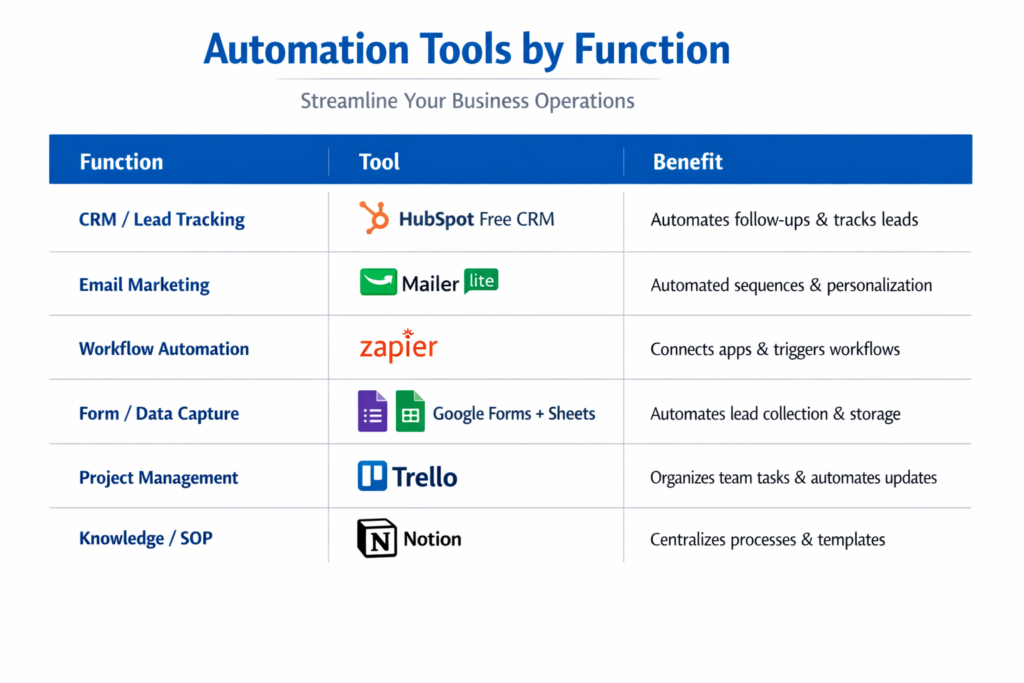
Automation Tools by Function

FunctionToolBenefit
CRM / Lead TrackingHubSpot Free CRMAutomates follow-ups & tracks leads
Email MarketingMailerLiteAutomated sequences & personalization
Workflow AutomationZapierConnects apps & triggers workflows
Form / Data CaptureGoogle Forms + SheetsAutomates lead collection & storage
Project ManagementTrelloOrganizes team tasks & automates updates
Knowledge / SOPNotionCentralizes processes & templates

Step-by-Step Example Workflow: Lead Follow-Up Automation:

Lead Follow-Up Automation is what we are going to talk about.

The main goal is to automate follow-ups for leads so we can get more people to engage with us and turn them into customers.

Best Automation Tools for Small Businesses (No Paid Ads Needed)

We will use a tool to do this:

  • Google Forms
  • Google Sheets
  • Zapier
  • MailerLite

Here is how we do it:

  • Step 1: We create a Google Form to get information from leads.
  • Step 2: When people fill out the form their answers automatically go into Google Sheets.
  • Step 3: Then Zapier tells MailerLite to send an email to the new lead.
  • Step 4: After that MailerLite sends another email to the lead 2 days to follow up.
  • Step 5: We separate the leads, into groups based on how they engage with us so we can plan our future email campaigns better.

Best Practices for Small Business Automation

  • When you are getting started with Small Business Automation start simple. Focus on one workflow at a time for Small Business Automation.
  • You should document all of your processes for Small Business Automation. You can use tools like Notion or Trello to track all of your workflows for Small Business Automation.
  • You need to test all of your workflows for Small Business Automation. Make sure all of the triggers fire correctly and that all of the data flows as you expect it to for Small Business Automation.
  • It is also an idea to monitor your metrics for Small Business Automation. You should track things like email opens and clicks and lead conversions and response times, for Small Business Automation.

Common Mistakes to Avoid:

MistakeEffectSolution
Automating too many processes at onceConfusion & errorsStart small and scale gradually
Ignoring performance trackingLeads not convertingSet KPIs and measure results
Impersonal communicationLower engagementUse personalized fields in emails
No backupsLost automation setupRegularly export data and workflows

Checklist: Are You Ready to Automate Your Small Business?

  • Find tasks you do over. Over
  • Pick free tools that work for you
  • Create a plan for automating tasks
  • Try it out. See if it works
  • Keep an eye, on numbers often
  • Make changes based on how things are going

Conclusion:

For small businesses, automation is no longer just a convenience it has become an essential part of sustainable growth. As your business expands, managing leads, customer communication, marketing campaigns, and daily operations manually can quickly become overwhelming. The right automation tools help simplify these tasks, allowing your team to focus on building relationships, improving products, and serving customers instead of repetitive administrative work.

Platforms such as HubSpot CRM, MailerLite, Trello, Zapier, Google Forms, and Notion make it easier to organize workflows, automate routine tasks, reduce human errors, and improve customer engagement without requiring a large marketing budget. Even simple automations, like sending follow-up emails, assigning tasks automatically, or collecting customer data, can save hours of work every week.

The key is to start with one or two processes, monitor their performance, and continuously optimize them as your business grows. Small improvements made over time can lead to significant gains in productivity, customer satisfaction, and revenue. By embracing business automation today, small businesses can operate more efficiently, make smarter decisions, and achieve long-term growth while keeping costs under control.

August 1, 2026 0 comment
0 FacebookTwitterPinterestEmail
B2B marketing

B2B Sales Automation Best Practices to Build a Smarter Sales Process

by ailcia sierra July 17, 2026
written by ailcia sierra

The B2B sales environment is getting tougher every day. Businesses are not just competing on price. What their products can do. They are competing on how they can move how well they can personalize things for their customers the experience they give their customers and how well they can set up their sales processes to work smoothly.

As companies get leads from different places it is getting harder to keep track of everything by hand. Sales teams need to keep an eye on what’s happening with their customers get back to potential customers quickly make sure their information is correct and send messages that are personalized while dealing with more and more sales.

This is making things more complicated. That is why sales automation is becoming a big part of what businesses do to get more done and make sure they have a steady stream of revenue.

However just buying a sales automation platform does not mean a business will be successful. A lot of businesses buy automation tools. They do not get the results they want because they do not have a good plan for how to use them.

To automate sales successfully a business needs more than technology. They need to know what they want to achieve with their sales have a process in place have good information, about their customers train their teams and always be looking for ways to improve.

This is where B2B Sales Automation Best Practices come in.

B2B Sales Automation Best Practices help businesses use automation in a way not just as another piece of software. When automation is done right it can help businesses manage their leads better speed up their sales get customers more engaged and help sales teams focus on the things that will make the money for the business.

Understanding B2B Sales Automation Best Practices

B2B Sales Automation Best Practices are ways to do things that help companies get the most out of automation technology and still have good relationships with their customers. Automation is not meant to replace the things that sales people do. It is meant to make the work of sales teams better.

When a company has an automation process it helps them figure out some important things.

Understanding B2B Sales Automation Best Practices

A well-designed automation process helps businesses answer important questions:

  • Which leads should sales teams prioritize?
  • How can customer communication become more personalized?
  • Where are prospects dropping from the sales funnel?
  • Which sales activities consume the most time?
  • How can sales teams improve conversion rates?

By answering these questions, businesses can design automation workflows that support their specific goals.

Without Proper Automation StrategyWith B2B Sales Automation Best Practices
Random tool implementationGoal-based automation strategy
Manual repetitive tasksAutomated workflows
Poor customer trackingOrganized customer data
Slow follow-upsTimely communication
Limited sales visibilityReal-time insights
Inconsistent processesStandardized workflows

The purpose of automation is not simply to complete tasks faster. The real goal is to create a smarter sales ecosystem where every activity contributes to business growth.

Why Businesses Need a Strategic Approach to Sales Automation

Many businesses make the mistake of focusing only on selecting a sales automation tool. While choosing the right platform is important, the strategy behind using that platform determines success. A company can have the most advanced automation software available, but if sales processes are unclear, customer data is inaccurate, or teams are not trained, results will remain limited.

A strategic automation approach begins with understanding existing sales challenges. For example, a company experiencing low conversion rates may not need more leads. It may need better lead qualification and follow-up processes.

Another company may generate enough opportunities but lose customers because sales representatives respond too slowly. Automation helps solve these challenges, but only when businesses identify the right areas for improvement.

Business ChallengeAutomation Solution
Slow lead responseAutomated notifications and follow-ups
Poor lead qualityAI-powered lead scoring
Missed opportunitiesAutomated reminders
Manual reportingSales dashboards
Weak personalizationCustomer-based workflows

A strategic approach ensures that automation supports business objectives instead of creating unnecessary complexity.

Best Practice 1: Define Clear Sales Automation Goals

The thing you need to do is figure out what you want to achieve with sales automation.

Sales automation is a deal and you need to know what you want from it. Businesses should know why they want to use sales automation before they pick the tools they will use or set up their workflows. If you do not have goals it can be really hard to keep your sales automation efforts on track and measure how well they are working.

Common goals include improving:

  • Lead conversion rates
  • Sales productivity
  • Customer engagement
  • Sales cycle speed
  • Revenue forecasting
  • Team efficiency

For example, a company may set a goal to reduce lead response time from several hours to a few minutes through automated notifications.

Best Practice 2: Analyze Your Existing Sales Process Before Automating

One of the most important B2B Sales Automation Best Practices is understanding the current sales workflow before introducing automation.

Automation works best when businesses first identify which activities need improvement. Many organizations try to automate inefficient processes without fixing the underlying problems. This creates a situation where businesses simply complete ineffective tasks faster.

Before automation, companies should analyze:

  • How leads enter the sales funnel
  • How prospects are qualified
  • How sales representatives follow up
  • Where customers experience delays
  • Which activities consume the most time

For example, if sales representatives spend several hours manually updating CRM records, automation can solve this challenge.

However, if the sales process itself is unclear, automation will not solve the problem.

Sales Process StageQuestions to Analyze
Lead GenerationWhere do leads come from?
Lead QualificationHow are valuable prospects identified?
CommunicationHow are customers contacted?
Follow-UpHow are reminders managed?
ClosingWhat delays conversions?

Understanding the existing process helps businesses create automation workflows that actually improve performance.

Best Practice 3: Maintain High-Quality Customer Data

Customer data is really important for sales automation to work well. Sales automation depends on customer information to make communication personal find new opportunities and get accurate ideas about what is going on. Customer data is the foundation of every sales automation strategy. If the customer data is not good it can hurt the results of the sales automation.

For example, outdated customer information can lead to:

  • Incorrect targeting
  • Poor personalization
  • Duplicate records
  • Wrong sales decisions

Businesses should regularly maintain their customer databases by updating information and removing unnecessary records.

Important data management activities include:

Data Management ActivityBusiness Benefit
Updating customer detailsBetter communication
Removing duplicatesCleaner CRM
Maintaining accurate recordsImproved insights
Organizing customer segmentsBetter targeting
Monitoring data qualityReliable automation

High-quality data allows automation systems to perform more effectively and create better customer experiences.

Best Practice 4: Personalize Automated Sales Communication

One of the challenges businesses face with automation is keeping a personal touch. When companies use automation they can send messages fast but customers do not like getting messages that seem like they are not meant for them.

People who buy things from businesses these days expect businesses to know what problems they are trying to solve what their company needs and what they want to achieve before they decide to buy something.

Automation platforms can help businesses create different customer journeys based on:

  • Industry
  • Company size
  • Customer interests
  • Previous interactions
  • Buying stage
  • Website behavior

This allows businesses to deliver the right message to the right audience at the right time.

Personalization MethodHow Automation Helps
Customer segmentationGroups prospects based on characteristics
Behavioral trackingUnderstands customer interests
Email personalizationCreates targeted messages
Content recommendationsProvides relevant resources
Follow-up timingContacts customers at suitable moments

Personalization improves engagement because customers receive communication that matches their specific requirements.

Best Practice 4: Personalize Automated Sales Communication

Creating Effective Automated Email Sequences

Email automation remains one of the most widely used sales automation strategies. However, successful email automation requires careful planning.

Many businesses make the mistake of creating aggressive promotional email campaigns that focus only on selling. Modern B2B customers prefer valuable information, industry insights, and solutions to their problems. A strong automated email sequence should guide prospects through the buying journey.

A typical B2B sales email workflow may include:

Sales Journey StageEmail Purpose
First interactionIntroduce brand and value
Awareness stageShare educational content
Consideration stageProvide solutions and case studies
Decision stageEncourage sales conversation
Post-purchase stageBuild customer relationship

The goal of email automation is not to send more emails. The goal is to create meaningful communication that helps customers make better decisions.

Best Practice 5: Use AI to Improve Sales Automation

AI is really important, for sales automation these days.

Traditional automation systems just did what they were told. AI powered platforms can look at information find patterns and give smart suggestions.

Using AI is one of the things you can do for B2B Sales Automation because it helps businesses go from just automating simple tasks to really managing sales in a smart way.

AI can improve different areas of sales operations, including:

  • Lead qualification
  • Customer prediction
  • Sales forecasting
  • Personalized recommendations
  • Communication optimization

For example, AI can analyze thousands of customer interactions and identify which prospects have higher buying potential.

This allows sales teams to focus their efforts on valuable opportunities.

AI CapabilitySales Benefit
Predictive lead scoringIdentifies high-value prospects
AI recommendationsSuggests next actions
Customer analysisUnderstands buying behavior
ForecastingImproves revenue planning
Automated insightsSupports better decisions

AI does not replace sales professionals. Instead, it gives them better information and helps them work more effectively.

AI-Powered Lead Scoring for Better Sales Decisions

Lead scoring is very important for B2B sales because every person who might buy something from you is not the same.Some people are more likely to buy than others. Without figuring out who is a prospect sales teams can spend a lot of time on people who will probably not buy anything.

Traditional lead scoring usually depends on basic information such as:

  • Job role
  • Company size
  • Industry
  • Website activity

AI-powered lead scoring goes further by analyzing multiple data points.

AI can evaluate:

  • Customer engagement patterns
  • Content interactions
  • Email responses
  • Product interest
  • Previous communication

This creates more accurate predictions about customer intent.

Traditional Lead ScoringAI-Based Lead Scoring
Uses fixed rulesLearns from customer behavior
Limited data analysisUses multiple data sources
Manual updatesContinuous improvement
Basic qualificationPredictive insights

Better lead scoring allows sales teams to prioritize the right opportunities and improve conversion rates.

Best Practice 6: Align Sales and Marketing Teams

Sales and marketing teams working together is really important for automation to be successful. In a lot of companies the sales team and the marketing team do their thing. The marketing team tries to get people interested in what the company’s selling and the sales team tries to turn those people into customers.

When these teams do not share information, businesses often experience problems such as:

  • Poor lead quality
  • Delayed follow-ups
  • Inconsistent messaging
  • Lower conversion rates

B2B Sales Automation helps create better collaboration by connecting sales and marketing data.

Marketing teams can understand which campaigns generate valuable opportunities, while sales teams can access customer engagement information.

Sales and Marketing Alignment AreaAutomation Impact
Lead sharingFaster sales response
Customer dataBetter understanding
Campaign trackingImproved marketing decisions
CommunicationConsistent messaging
Performance analysisBetter revenue planning

A connected sales and marketing process creates a smoother customer journey.

Best Practice 7: Train Sales Teams Before Implementing Automation

Technology alone cannot guarantee sales success. One of the most overlooked B2B Sales Automation Best Practices is proper employee training. Sales representatives need to understand how automation tools work and how these platforms can improve their daily activities.

Without training, teams may avoid using automation tools or fail to use important features.

Training should cover:

  • CRM usage
  • Workflow management
  • Lead tracking
  • Data management
  • Reporting features
  • Customer communication

A successful training program helps employees understand that automation is not replacing their role. Instead, it removes repetitive work and allows them to focus on more valuable activities.

Training AreaExpected Improvement
Platform knowledgeBetter tool adoption
Workflow understandingMore efficient processes
Data managementHigher accuracy
Reporting skillsBetter decision-making
Automation usageIncreased productivity

Employee adoption plays a major role in achieving automation success.

Best Practice 8: Create Optimized Sales Workflows

A sales workflow is really important for sales automation to work well.

Sales workflows are like a map that shows how people who are interested in what you’re selling move through the different stages of buying something from you. A good sales workflow makes sure that every person who is interested in what you’re selling gets the right kind of attention based on what they are looking at and what they are doing.

For example:

A visitor downloads a business guide → automation captures their information → lead score increases → salesperson receives notification → personalized follow-up begins.

This process ensures faster response and better customer engagement.

A typical automated sales workflow includes:

Workflow StageAutomation Activity
Lead captureCollect customer information
QualificationEvaluate lead quality
NurturingSend relevant communication
Sales engagementNotify representatives
ConversionTrack opportunity progress

Businesses should regularly review and improve workflows based on performance data.

Best Practice 9: Track Performance and Continuously Improve

Sales automation is not a one-time implementation. Businesses need continuous monitoring and optimization.

Regular performance analysis helps companies understand what is working and what requires improvement.

Important metrics include:

Performance MetricImportance
Lead conversion rateMeasures sales effectiveness
Response timeShows customer engagement speed
Sales cycle lengthTracks process efficiency
Customer acquisition costEvaluates investment
Revenue growthMeasures business impact
Customer retentionShows relationship quality

For example, if automated emails have low engagement rates, businesses can test different messaging, timing, or customer segments.

Continuous improvement ensures that automation strategies remain effective as customer expectations change.

Best Practice 10: Maintain a Balance Between Automation and Human Interaction

Automation is great for getting things done quickly. People are still important in business to business sales .B2B sales are often complicated and involve a lot of people so it is good to have interaction. Customers like to talk to people who know what they are going through.

Automation should handle repetitive activities such as:

  • Scheduling meetings
  • Sending reminders
  • Organizing information
  • Updating records

Sales professionals should focus on:

  • Understanding customer needs
  • Providing consultation
  • Building trust
  • Negotiating solutions

The most successful businesses combine automation efficiency with human expertise.

How to Measure the Success of Your B2B Sales Automation Strategy

Implementing automation is only the beginning of the journey. To understand whether your investment is delivering value, businesses need to measure performance consistently. One of the most effective B2B Sales Automation Best Practices is tracking key performance indicators (KPIs) that reflect the efficiency of the sales process and its contribution to business growth.

Without measurement, organizations cannot determine whether automation is improving lead quality, reducing response times, or increasing revenue. Continuous analysis helps sales leaders identify strengths, address weaknesses, and refine workflows as customer expectations evolve.

The following metrics are commonly used to evaluate the effectiveness of sales automation.

KPIWhy It Matters
Lead Conversion RateMeasures how many leads become customers
Sales Cycle LengthIndicates how quickly deals move through the pipeline
Response TimeTracks how quickly prospects receive replies
Customer Acquisition Cost (CAC)Shows the cost of acquiring new customers
Revenue GrowthMeasures the business impact of automation
Customer Retention RateIndicates long-term relationship success
Sales ProductivityEvaluates how efficiently sales teams use their time

Tracking these KPIs regularly allows businesses to optimize their sales processes instead of relying on guesswork.

Calculating the Return on Investment (ROI) of Sales Automation

Every technology investment should generate measurable business value. Calculating the return on investment (ROI) helps organizations understand whether their sales automation strategy is producing financial benefits.

ROI is not limited to increased revenue. It also includes time savings, higher productivity, reduced operational costs, and improved customer retention.

Calculating the Return on Investment (ROI) of Sales Automation

For example, if automation reduces administrative work by several hours each week for every sales representative, those saved hours can be redirected toward customer conversations and closing deals. This creates value that extends beyond immediate revenue.

When evaluating ROI, businesses should consider both direct and indirect benefits.

Investment AreaBusiness Outcome
Workflow automationReduced manual effort
AI lead scoringHigher-quality opportunities
Automated follow-upsFaster customer engagement
Sales analyticsBetter decision-making
CRM integrationImproved collaboration
Employee productivityMore time for selling

A well-planned automation strategy often delivers long-term value by improving efficiency across the entire sales organization.

Common Mistakes Businesses Should Avoid

Avoiding common implementation mistakes helps businesses maximize the benefits of sales automation and improve long-term performance.

1. Automating Inefficient Processes: Optimize your sales workflow before automating it to eliminate unnecessary steps and improve overall efficiency.

2. Focusing Only on Technology: Combine automation tools with clear sales goals, skilled teams, and strong processes to achieve better business results.

3. Ignoring Customer Experience: Use automation to enhance customer interactions while keeping important conversations personal and relationship-focused.

4. Using Too Many Automation Tools: Build an integrated technology stack to reduce complexity, improve data consistency, and streamline sales operations.

5. Neglecting Employee Training: Provide regular training so sales teams can confidently use automation tools and maximize their effectiveness.

Future Trends in B2B Sales Automation

The way we do B2B sales automation is changing. This is because intelligence and machine learning are getting better. Businesses need to know about technologies to work smarter and make customers happy. There are some trends that will shape the future of B2B Sales Automation Best Practices.

1. AI Sales Agents

AI sales agents are becoming increasingly capable of performing complex tasks beyond simple workflow automation.

These intelligent systems can:

  • Identify qualified prospects
  • Analyze buying intent
  • Recommend personalized messaging
  • Schedule meetings
  • Update CRM records
  • Provide sales recommendations

Rather than replacing sales representatives, AI sales agents will act as intelligent assistants that improve productivity and decision-making.

2. Predictive Revenue Intelligence

Modern sales platforms are moving toward predictive revenue intelligence. Instead of simply reporting historical performance, future systems will analyze customer behavior and forecast future sales opportunities.

Predictive analytics will help businesses:

  • Identify high-value accounts
  • Forecast revenue more accurately
  • Detect pipeline risks
  • Improve resource planning
  • Optimize sales strategies

This allows organizations to make proactive decisions rather than reacting after problems occur.

3. Hyper-Personalized Customer Experiences

Personalization will continue to become more sophisticated. Future automation platforms will look at what customers like how they browse, how they engage and what they buy. They will use this information to give customers experiences that’re just for them.

Examples include:

  • Customized email content
  • Personalized product recommendations
  • Dynamic sales messaging
  • Individual follow-up schedules

This level of personalization will improve engagement and strengthen customer relationships.

4. Autonomous Sales Workflows

The next generation of sales automation will focus on autonomous workflows. Instead of automating individual tasks, intelligent platforms will manage complete sales processes with minimal manual intervention.

A future workflow may look like this:

  • A prospect visits a website → AI evaluates buying intent → the system qualifies the lead → personalized communication begins automatically → a meeting is scheduled → CRM records are updated → sales managers receive real-time insights.

These autonomous workflows will help businesses improve efficiency while allowing sales professionals to focus on strategic conversations.

Building a Future-Ready Sales Organization

Technology will continue to evolve, but successful sales organizations will always combine innovation with strong customer relationships.

Businesses should view automation as an ongoing journey rather than a one-time project.

Future-ready organizations focus on:

Strategic FocusLong-Term Benefit
Continuous optimizationBetter sales performance
AI adoptionSmarter decision-making
Data qualityMore accurate insights
Employee developmentHigher productivity
Customer-centric strategiesStronger relationships
Scalable technologySustainable business growth

Companies that invest in continuous improvement will remain competitive in a rapidly changing B2B marketplace.

Conclusion

Implementing B2B Sales Automation Best Practices is about more than adopting new technology. It requires a strategic approach that combines optimized workflows, accurate data, artificial intelligence, employee training, and continuous performance measurement.

Businesses that clearly define their goals, personalize customer communication, integrate automation with existing systems, and regularly optimize their processes can achieve significant improvements in productivity, lead conversion, and revenue growth.

Automation should empower sales professionals rather than replace them. By allowing technology to handle repetitive administrative tasks, sales teams gain more time to build meaningful relationships, solve customer challenges, and close high-value deals.

As AI, predictive analytics, and autonomous workflows continue to evolve, organizations that embrace these best practices will be well positioned to build scalable, efficient, and customer-focused sales operations that support long-term success.

July 17, 2026 0 comment
0 FacebookTwitterPinterestEmail
B2B marketing

B2B Sales Automation Explained: How Businesses Are Transforming Their Sales Process

by ailcia sierra July 10, 2026
written by ailcia sierra

In the business world today sales teams have to deal with a lot of pressure to find good leads turn them into customers make the sales process faster and build stronger relationships with customers.. The old way of doing sales involves a lot of boring tasks like typing in data sending follow up emails tracking leads and researching customers, which takes up a lot of time and makes sales teams less efficient.

This is where B2B Sales Automation comes in as a help for companies that want to make their sales process faster smarter and better. By using automation technology, customer relationship management, artificial intelligence and looking at data to make decisions businesses can make their whole sales process simpler. Let sales people focus on important things.

B2B Sales Automation helps companies automate the parts of sales while making lead management, communication, forecasting and making money better. Of spending hours working with spreadsheets and manually following up with potential customers sales teams can use automated workflows to take care of leads prioritize good opportunities and give customers a personalized experience.

As more companies compete with each other they are moving away from the way of selling and, towards using automation to make their sales process better which helps them be more productive and make more money in a predictable way.

What Is B2B Sales Automation?

B2B Sales Automation is, about using software, automation tools and artificial intelligence to make B2B sales easier.

In a B2B sales setup sales reps do everything manually. They search for potential customers send emails, update CRM records, schedule meetings qualify leads and track sales chances. These tasks are important. Doing them manually can slow down sales and create problems.

What Is B2B Sales Automation?

B2B sales automation helps by creating systems that do tasks automatically giving sales teams useful information.
A modern sales automation system can help businesses:

  • Capture and organize leads automatically
  • Send personalized email sequences
  • Track prospect interactions
  • Score and qualify leads
  • Automate follow-ups
  • Update CRM information
  • Analyze sales performance
  • Improve sales forecasting

The main goal of sales automation is not to replace sales professionals but to enhance their capabilities by reducing administrative workload and improving decision-making.

How Does B2B Sales Automation Work?

B2B Sales Automation works by connecting different sales activities into a structured automated workflow. It uses customer data, predefined rules, artificial intelligence, and automation tools to manage interactions throughout the buyer journey.

A typical automated sales workflow includes several stages:

Sales StageTraditional ProcessAutomated Process
Lead GenerationManual prospect searchingAutomated lead collection
Lead QualificationSalesperson reviews every leadAI-based lead scoring
OutreachManual emails and callsAutomated email sequences
Follow-upsDepends on salesperson remindersScheduled automated follow-ups
CRM ManagementManual data entryAutomatic CRM updates
ReportingManual analysisReal-time sales dashboards

This allows sales teams to spend more time building relationships and closing deals instead of managing repetitive activities.

Why Businesses Are Moving Toward Sales Automation

The way businesses sell to businesses has gotten really complicated. Now customers do their research online they compare different companies they read what other people think and they want to be treated like they are the only customer before they even talk to a sales person.

Because of all these changes businesses need to sell in a way that’s faster and smarter and really focused on what the customer wants.

There are some reasons why companies are using Sales Automation for their business to business sales.

1.Increasing Sales Productivity

Sales people usually spend a lot of time doing things that do not make them any money, like updating records setting up meetings and sending the messages over and over.

Sales Automation helps with these tasks and lets sales teams focus on the things that actually make money like:

  • Building customer relationships
  • Understanding buyer needs
  • Negotiating deals
  • Closing opportunities

A productive sales team is not only about working harder but also about using the right technology to work smarter.

2. Improving Lead Management

Managing hundreds or thousands of potential customers manually can become difficult. Without proper organization, businesses may lose valuable opportunities because leads are not contacted at the right time.

B2B Sales Automation helps companies organize leads based on:

  • Industry
  • Company size
  • Buying behavior
  • Engagement level
  • Previous interactions

Automated lead management ensures that sales teams can prioritize the prospects with the highest potential.

3. Creating Follow-Up Processes

When it comes to selling to other businesses timing is really important. If a business takes long to respond the customer might go somewhere else.

Sales Automation makes it possible for businesses to respond away and set up a plan to follow up with customers.

For example:

Someone visits a website and downloads a report → the Sales Automation system captures their information → sends them an email → sets reminders to follow up → assigns the customer to a sales person.

This makes the whole process smooth and easy, for the customer without the sales team having to check on things.

Key Components of B2B Sales Automation

A successful sales automation strategy includes multiple technologies working together.

1. CRM Automation

Customer Relationship Management (CRM) automation is a part of sales automation.

It helps businesses:

  • Store customer information
  • Track interactions
  • Manage opportunities
  • Monitor sales pipelines
  • Improve customer communication

CRM automation ensures that sales teams always have accurate and updated customer information.

2. Email Sales Automation

Email remains one of the most effective channels for B2B communication. However, sending individual emails to every prospect can be time-consuming.

Email automation helps businesses create:

  • Welcome sequences
  • Lead nurturing campaigns
  • Follow-up emails
  • Product updates
  • Sales outreach campaigns

Modern platforms also allow personalization based on customer behavior and interests.

Key Components of B2B Sales Automation
3. Lead Scoring Automation

Not every lead has the same value. Lead scoring helps businesses identify which prospects are more likely to become customers.

Automation tools analyze factors such as:

  • Website activity
  • Email engagement
  • Company information
  • Content downloads
  • Previous conversations

This allows sales teams to focus their efforts on high-quality opportunities.

4. AI-Powered Sales Automation

Artificial intelligence is making B2B sales automation more advanced by providing predictive insights and intelligent recommendations.

AI sales automation can help with:

  • Predicting customer buying behavior
  • Writing personalized outreach messages
  • Identifying sales opportunities
  • Analyzing conversations
  • Improving sales forecasting

AI-powered automation is helping companies create more intelligent and personalized sales experiences.

Types of B2B Sales Automation

B2B Sales Automation is really helpful for businesses because it covers all the stages of the sales process. This helps businesses to work efficiently get more leads and close deals faster. B2B Sales Automation is very useful for businesses.

1. Lead Generation Automation

Lead generation automation is a help to businesses. It automatically finds, collects and organizes people who might be interested in buying something. This creates a stream of good leads.

It can help with:

  • Identifying target companies
  • Collecting prospect information
  • Tracking website visitors
  • Finding buying signals
  • Creating targeted prospect lists

2. Sales Outreach Automation

Sales outreach automation makes communication easier. It sends emails, follow-ups and reminders that are personalized based on what the customer does.

Common automated outreach activities include:

  • Cold email campaigns
  • Follow-up sequences
  • Personalized messages
  • Meeting reminders
  • Prospect engagement tracking

3. Sales Pipeline Automation

Sales pipeline automation tracks opportunities, updates deal stages, and improves visibility throughout the sales journey.

Sales pipeline automation helps companies:

  • Track opportunities automatically
  • Update deal stages
  • Identify sales bottlenecks
  • Monitor revenue forecasts
  • Improve sales visibility

4. Customer Relationship Automation

Customer relationship automation helps businesses talk to customers regularly engage with them and keep them as customers.

It supports:

  • Automated customer updates
  • Personalized communication
  • Customer engagement tracking
  • Renewal reminders
  • Account management workflows

5. AI-Powered Sales Automation

AI-powered sales automation uses artificial intelligence to predict opportunities, personalize outreach, and recommend smarter sales actions.

AI can help sales teams:

  • Predict which leads are most valuable
  • Recommend the next best action
  • Generate personalized emails
  • Analyze customer conversations
  • Identify sales opportunities

Advantages of B2B Sales Automation

The introduction of sales automation to an organization leads to numerous benefits, especially for those seeking to better their efficiency, lower their costs, and maximize their revenue potential.

1. More Productivity in Sales

The main advantage of B2B sales automation is productivity increase.

Sales personnel spend less time on repetitive admin tasks and instead focus on efforts that require human intervention.

Automation allows teams to

  • Spend more time with prospects
  • Eliminate the need for manual reporting
  • Communicate faster
  • Effectively manage more leads

A fully automated sales team can have much bigger pipelines without additional effort on the part of team members.

2. Improved Lead Qualification

Finding suitable leads is one of the major problems in B2B sales.

Many companies end up wasting time on leads that won’t convert.

Sales automation allows companies to optimize lead qualification by studying client information and spotting leads with high conversion potential.

Automated lead qualification considers:

Qualification FactorHow Automation Helps
Company SizeIdentifies ideal customer profiles
IndustryMatches relevant prospects
EngagementTracks customer interest
Website ActivityMeasures buying intent
Previous InteractionUnderstands customer behavior

This helps sales teams focus their efforts where they have the highest chance of success.

3. Shorter Sales Cycles

Sales automation helps to speed up sales by following up with leads giving them instant answers and keeping them interested. This gets leads through the sales process and closes deals quicker.

4. Improved Sales Forecasting

Sales automation tools look at sales numbers to give businesses an idea of whats coming next. This helps them know how money they’ll make see how they’re doing and make smart choices.

5. Personalized Customer Experiences

Modern sales automation sends customers messages that fit their needs and interests. It does this by looking at how they behave what they like and where they are, in the buying process. This makes interactions more meaningful. Gets customers more engaged.

6. Reduced Sales Costs

Automating sales tasks that are done over and again helps businesses get more done spend less on sales and grow their sales efforts without spending a lot more money.

B2B Sales Automation Examples

B2B Sales Automation is used by industries to make sales processes easier to engage customers better and to increase sales.

1. SaaS Companies

Sales automation is helpful for SaaS companies. It helps them to take care of leads find out if a lead is interested send follow-ups automatically and make more people subscribe.

It helps SaaS companies:

  • Nurture trial users
  • Send product updates
  • Identify buying signals
  • Schedule product demonstrations
  • Improve subscription conversions

2. Marketing Agencies

Marketing agencies use sales automation to manage leads, automate follow-ups, and track client interactions more efficiently.

Automation helps agencies:

  • Capture website inquiries
  • Automate proposal follow-ups
  • Track client interactions
  • Manage sales pipelines

3. Financial Services Companies

Sales automation enables financial organizations to qualify prospects, automate communication, and strengthen customer relationship management.

Sales automation helps them:

  • Identify qualified prospects
  • Automate customer communication
  • Manage compliance processes
  • Improve relationship management

4. Manufacturing Companies

Manufacturers use sales automation to manage long sales cycles, improve follow-ups, and strengthen account management.

Automation helps manufacturers:

  • Track distributors
  • Manage business inquiries
  • Follow up with potential buyers
  • Improve account management

5. Enterprise Technology Companies

Enterprise technology companies use sales automation to make complex B2B sales easier and to engage customers better.

Automation supports:

  • Account-based selling
  • Enterprise lead management
  • Sales intelligence
  • Customer engagement

B2B Sales Automation vs Traditional Sales Process

FactorTraditional SalesB2B Sales Automation
Lead ManagementManual trackingAutomated organization
Follow-upsDepends on salespersonScheduled automatically
Data EntryTime-consumingAutomated updates
Customer InsightsLimited informationData-driven insights
ScalabilityRequires more employeesSupports business growth
ReportingManual analysisReal-time analytics

The major difference is that automation allows sales teams to become more efficient without losing the human element of relationship building.

How B2B Sales Automation Supports Revenue Growth

Revenue growth depends on generating quality leads, converting opportunities, and retaining customers. Sales automation supports each stage of this process.

It improves revenue performance by:

  • Increasing the number of qualified leads
  • Reducing response time
  • Improving sales team efficiency
  • Creating predictable workflows
  • Helping businesses make data-driven decisions

Companies that combine automation with effective sales strategies can build a more scalable revenue engine.

How B2B Sales Automation Supports Revenue Growth

How B2B Sales Automation Helps Increase Revenue

Revenue growth is, about getting good leads turning them into customers and keeping them. Sales automation helps with each of these steps.

It improves revenue performance by:

  • Increasing the number of qualified leads
  • Reducing response time
  • Improving sales team efficiency
  • Creating predictable workflows
  • Helping businesses make data-driven decisions

When companies use automation and good sales strategies together they can build a revenue system that can grow easily.

Best B2B Sales Automation Tools and Platforms

Choosing the right B2B Sales Automation platform is important because every business has different sales goals, customer journeys, and operational requirements.

A good sales automation solution should not only automate repetitive tasks but also provide valuable insights that help sales teams improve performance.

Modern sales automation platforms usually combine CRM capabilities, artificial intelligence, email automation, analytics, and workflow management.

Here are some common categories of sales automation tools:

Tool CategoryPurposeKey Features
CRM Automation PlatformsManage customer relationshipsContact management, pipeline tracking, reporting
Email Automation ToolsAutomate communicationEmail sequences, personalization, follow-ups
Sales Engagement PlatformsImprove prospect communicationMulti-channel outreach, engagement tracking
Lead Generation ToolsFind potential customersProspect discovery, data collection
AI Sales AssistantsImprove sales productivityRecommendations, content generation, insights
Analytics PlatformsMeasure performanceReports, forecasting, sales intelligence

Key Features to Look for in B2B Sales Automation Software

By selecting the best B2B sales automation software, companies can simplify their sales processes, increase their productivity, and achieve the best results.

1. CRM Integration: CRM integration synchronizes client information, enhances team collaboration, and provides insight into every customer interaction.

2. Lead Management: With automated lead management, leads can be captured, organized, scored and assigned rapidly. This allows sales teams to concentrate on the best opportunities.

3. AI-Based Sales Insights: AI processes the customer data and identifies prospects, predicts their buying behavior and gives recommendations on how to sell better.

4. Workflow Automation: Workflow automation allows reducing non-unique tasks such as help with leads, follow-ups, and emails thus making the selling process more efficient.

5. Sales Reporting: Sales reporting provides valuable information regarding the performance of campaigns, conversions, and selling processes.

How to Implement B2B Sales Automation Successfully

Implementing B2B sales automation requires a structured approach to improve efficiency, streamline workflows, and maximize sales performance.

Step 1: Identify Repetitive Sales Tasks

Identify time-consuming tasks such as follow-ups, CRM updates, lead scoring, and reporting that can be automated to improve productivity.

Step 2: Define Your Sales Goals

Set clear objectives, such as increasing qualified leads, improving conversions, shortening sales cycles, or enhancing customer engagement.

Step 3: Select the Right Sales Automation Platform

Choose a platform that fits your business needs by evaluating integration, scalability, AI capabilities, ease of use, and reporting features.

Step 4: Create Automated Sales Workflows

Design automated workflows that guide leads through the sales pipeline with timely communication and follow-up actions.

Step 5: Train Sales Teams

Train sales teams to effectively use automation tools, customer insights, and AI features while maintaining personalized customer interactions.

B2B Sales Automation Best Practices

To maximize results, businesses should follow proven sales automation practices.

1. Maintain Personalization

Automation should not make communication feel robotic. Businesses should use customer information to create personalized experiences.

Effective personalization includes:

  • Using customer names
  • Understanding industry challenges
  • Sharing relevant content
  • Providing solutions based on business needs

Personalization improves engagement and builds trust.

2. Keep Data Clean and Updated

Automation depends on accurate information.

Poor-quality data can create:

  • Incorrect targeting
  • Wrong communication
  • Poor sales decisions

Businesses should regularly clean customer databases and remove outdated information.

3. Combine Automation With Human Interaction

Automation should support sales teams, not replace relationship building.

Human interaction remains important for:

  • Complex negotiations
  • Enterprise deals
  • Customer relationships
  • Strategic conversations

The most successful companies combine automation efficiency with human expertise.

4. Measure Performance Regularly

Businesses should monitor automation results using important metrics.

Key metrics include:

MetricImportance
Lead Conversion RateMeasures sales effectiveness
Response TimeShows communication speed
Sales Cycle LengthMeasures efficiency
Customer Acquisition CostTracks spending effectiveness
Revenue GrowthMeasures business impact

Regular measurement helps businesses improve their automation strategy.

Common Mistakes Businesses Make With Sales Automation

Ineffective execution can make B2B sales automation less efficient and also affect relations with clients.

1. Automation Implementation Without Planning

Executing automation without any defined sales plan can lead to inefficient processes.

2. Excessive Automation of Customer Correspondence.

Too many automated messages may be confounding for potential clients, hence businesses should strive for timely and meaningful communication instead.

3. Underestimating Data Quality

Poor-quality or obsolete client data can reduce the efficiency of your campaigns and bring less than satisfactory sales outcomes.

4. Failure to Align Sales and Marketing Staff

Good cooperation between sales and marketing leads to better lead quality, better communication with clients, and ultimately better profit growth.

Future of B2B Sales Automation

The future of sales automation will be heavily influenced by artificial intelligence, predictive analytics, and intelligent automation.

Businesses are moving toward more advanced systems that can understand customer behavior and make proactive recommendations.

Future trends include:

1. AI Sales Agents

AI sales agents will help businesses automate tasks such as:

  • Prospect research
  • Customer conversations
  • Lead qualification
  • Meeting scheduling

These systems will work alongside human sales professionals to improve productivity.

2. Predictive Sales Intelligence

Predictive analytics will help companies understand which prospects are most likely to convert.

Businesses will use data-driven insights to:

  • Prioritize leads
  • Improve forecasting
  • Create better strategies
3. Autonomous Sales Workflows

Future sales systems will become more intelligent by automatically managing complete sales workflows.

For example:

A system may identify a potential customer, analyze their needs, send personalized communication, schedule meetings, and update CRM records automatically.

Conclusion

B2B Sales Automation is changing the way companies find customers talk to them and make more money. This happens when companies use machines to do tasks and make decisions based on what the numbers tell them. This way companies can make their sales process faster, smarter and bigger.

Nowadays sales teams are not just competing with each other by having products or services. They are also competing by being better at getting things done making customers happy and using technology in a way.

Companies that use B2B Sales Automation correctly can get work done have more chances to make a sale and create a system that always brings in new sales.

The future of B2B sales is for companies that use machines to do some of the work. Also use people to be creative build relationships and make big decisions, about what to do next. B2B Sales Automation is going to be a part of this.

Frequently Asked Questions (FAQs)

1. What does B2B Sales Automation mean?

B2B Sales Automation is the term for technology and artificial intelligence (AI) used to streamline manual procedures in the selling process like finding prospects, making follow-ups, updating customer relationship management (CRM) system, and reporting.

2. How B2B Sales Automation functions?

The technology works by automating all the tasks and processes of sales through data & customer activity tracking, leads scoring, customer communication, and CRM updating.

3. What advantages does B2B Sales Automation offer?

B2B Sales Automation makes sales more productive, effective in lead qualification, quicker, improves customer experience, and enhances sales forecasting.

4. What does AI do in B2B Sales Automation?

Artificial Intelligence is valuable in B2B Sales Automation since it helps to analyze customers’ data to find high-quality leads that need more personalized messages.

5. Which tasks can be automated in B2B Selling?

Automated lead management, email campaigns, follow-ups, meetings planning, and pipeline reporting can all be done in B2B sales.

July 10, 2026 0 comment
0 FacebookTwitterPinterestEmail

Latest Posts

  • 1

    Why ABM Strategies Fail and How to Fix Them

    August 21, 2026
  • 2

    What Is Social Media SEO? How to Improve Your Visibility on Social Platforms

    August 17, 2026
  • 3

    The Rise of LLM Supply Chain Attacks in AI Search Ecosystems

    March 28, 2026
  • 4

    How to Build a Secure API: A Step-by-Step Guide

    May 19, 2025
  • 5

    Finance Policies for Indian Business in 2025: Key Updates & Insights

    May 6, 2025

Address

INDIA

Office No. 612, Wing A, Orville Business Port, Viman Nagar, Pune, Maharashtra 411014

US

2166 W Broadway, 1056, Anaheim, California 92804, US

Phone : +91 9766115291

US Number : +1 657-582-3789

Email : info@arkentechpublishing.com

About Us

With the constant evolution of modern technologies and innovative marketing solutions businesses now are reaching new heights however it takes time and efforts to identify the right effective strategies to market Your business you’re our architect technology publishing display accurate marketing solutions which will fuel up your business growth.

Categories

  • Abm Marketing (7)
  • Analytics (8)
  • API (4)
  • Application Development (5)
  • Artificial Intelligence (15)
  • Audit And Compliance (1)
  • Automation (3)
  • B2B marketing (14)
  • Banking (2)
  • Big Data (5)
  • Cloud Computing (9)
  • Cloud Migration (4)
  • Content Marketing (4)
  • Data Management (6)
  • Data Security (3)
  • Digital Advertising (7)
  • Ebook (3)
  • Ecommerce (3)
  • Erp (6)
  • Finance (67)
  • Finance 2025 (7)
  • Hrtech (88)
  • Insurances (2)
  • IOT (1)
  • IT Infrastructure (4)
  • IT Management (8)
  • IT Security (6)
  • Marketing (54)
  • Marketing 2025 (10)
  • MSP (1)
  • Networking And Communication (3)
  • Security (16)
  • Stock Market (3)
  • Storage (1)
  • Supply Chain (4)
  • Technology (122)
  • Technology 2025 (10)
  • Web Development (4)
<

Edtior's Picks

stock market analysis 2025S: Key Trends, Investment Tip
Stock Market
Stock Market Analysis 2025
NetApp All-SAN Array – Data Availability and Integrity with the NetApp ASA
Finance
NetApp All-SAN Array – Data Availability and Integrity with the NetApp ASA
lucid-origin_Creative_Image_Generation_Prompt_No_Text_16_9_A_visually_striking_eCommerce_auto-0
Best Ecommerce Automation Tools to Grow Your Business and Increase Sales
No posts found

Latest Articles

Why ABM Strategies Fail and How to Fix Them
Abm Marketing
Why ABM Strategies Fail and How to Fix Them
How to Use Marketing Analytics to Improve Campaign Performance
Analytics
How to Use Marketing Analytics to Improve Campaign Performance
lucid-origin_🔴_Deep_Reddish_plus_Vintage_B2B_Intent_Data_Prompt_Create_a_highly_creative_r-0
B2B marketing
What Is B2B Intent Data? How Businesses Identify High-Intent Buyers and Generate Better Leads
No posts found

Subscribe To Our NewsLetters

Stay updated with the latest news, insights, and exclusive updates delivered straight to your inbox. Subscribe to our newsletter and never miss important announcements, expert tips, and special offers. Be part of our growing community and get valuable content that inspires, informs, and helps you stay ahead. Sign up today!

Subscribe
arkentech-publishing-main-logo-footer

Arkentech Solutions is a marketing agency that caters to Enterprise and Technology companies across the globe to improve ROI on their marketing spend. 

Certified by TopCertifier
Instagram Linkedin

Useful Links

    • IT Security
    • Big Data
    • Technology
    • Finance
    • IT Management
    • HRTECH
    • Marketing

SIte Map

    • Home
    • About Us
    • Work With Us
    • Terms of Use
    • Privacy Policy
    • Feedback
    • Contact Us
Copyright © 2026 Arkentech Publishing